
The Samburu Special Five – Grevy’s zebra, reticulated giraffe, Beisa oryx, gerenuk, and Somali ostrich – are rare animals found in northern Kenya’s Samburu National Reserve. Unlike Africa’s Big Five, these species are uniquely adapted to survive in semi-arid environments. They rely on behaviors like consuming moisture-rich plants and enduring extreme heat, making them distinct to this region.
Key facts:
- Grevy’s Zebra: Largest wild equine; endangered with only 3,000 left.
- Reticulated Giraffe: Known for its striking coat; fewer than 16,000 remain.
- Beisa Oryx: Thrives in arid areas; near-threatened due to habitat loss.
- Gerenuk: Stands on hind legs to feed; near-threatened.
- Somali Ostrich: Blue-skinned bird; vulnerable from hunting and habitat loss.
Samburu National Reserve, spanning 64 square miles, provides critical habitats for these species. The Ewaso Ng’iro River sustains life in this tough terrain, supporting both wildlife and local communities. Conservation efforts by groups like the Grevy’s Zebra Trust and Northern Rangelands Trust are crucial, as threats like habitat loss, poaching, and climate change continue to challenge these species’ survival.
Visiting during dry seasons (June–October, December–March) offers the best chance to see all five species. Staying in eco-friendly lodges and working with local guides enhances the experience while supporting conservation efforts.
Samburu’s Special Five | Hidden Gems of Northern Kenya 🦒
sbb-itb-024d109
Samburu National Reserve: Where the Special Five Live
Nestled in northern Kenya, Samburu National Reserve covers 64 square miles (165 km²) of rugged, semi-arid terrain. Its landscape is a mix of rocky hills, dry scrublands, and open grasslands, creating diverse micro-habitats that support the Special Five and other wildlife species. The reserve’s tough climate has shaped species uniquely suited to thrive in these conditions. At the heart of this ecosystem lies a vital water source that sustains life across the reserve.
Ewaso Ng’iro River: The Lifeline of Samburu
The Ewaso Ng’iro River winds through the reserve, providing a critical water source for animals like elephants and Grevy’s zebras. This river also supports a lush riverine ecosystem, home to Nile crocodiles that can grow up to 20 feet (6 meters) long, hippos, and a variety of birds such as kingfishers and herons. Towering acacia trees along the riverbanks offer shade and nourishment, while elephants have been known to dig into the dry riverbed to uncover hidden water supplies.
"The Ewaso Ng’iro River is the lifeblood of Samburu, supporting both wildlife and local communities." – Samburu National Reserve Website
The river’s influence extends beyond its banks, shaping the survival strategies of the area’s unique species across Samburu’s varied habitats.
A Patchwork of Habitats and Wildlife
Samburu’s landscape is a network of habitats, each catering to different members of the Special Five. Near the Ewaso Ng’iro River, riverine forests attract reticulated giraffes and Grevy’s zebras, which feed on the acacia trees flourishing in the fertile soil. Just a short distance from the river, dense acacia woodlands provide ideal feeding areas for gerenuks, known for their ability to stand upright on their hind legs to reach higher foliage.
In the drier scrublands and open grasslands farther from the river, species have adapted to the harsh, arid conditions. Beisa oryx, for instance, graze on moisture-rich plants during cooler times of the day, maximizing hydration. Somali ostriches roam the open plains, their bare blue skin helping them release heat in the blazing sun. The open terrain also gives them a clear view of potential predators. This intricate mix of habitats ensures the survival of Samburu’s distinct wildlife, each species perfectly in tune with its environment.
The Samburu Special Five: Species Profiles
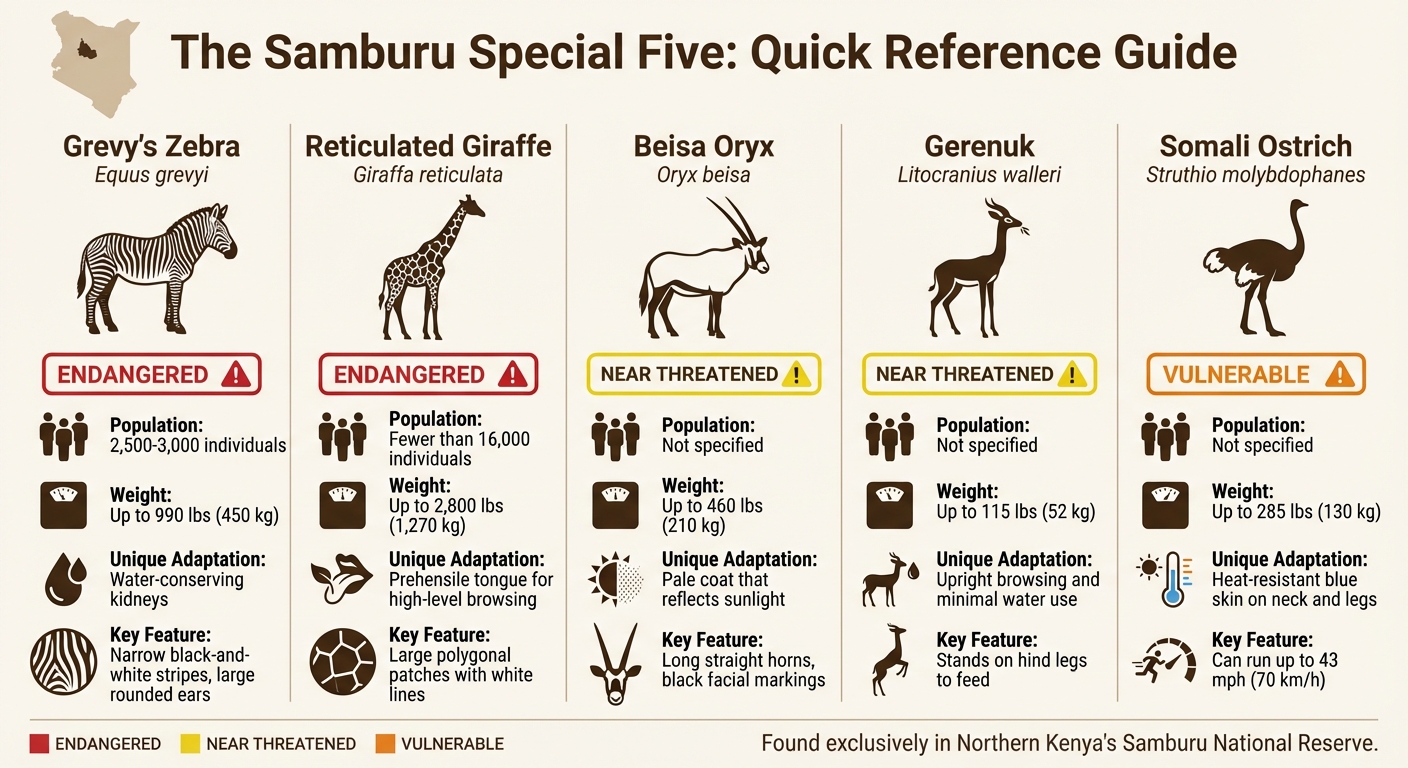
Samburu Special Five Species Comparison: Size, Status & Adaptations
The Samburu Special Five are a group of rare species that have evolved to thrive in the challenging, semi-arid landscapes of northern Kenya. Below, you’ll find a closer look at each species, highlighting their unique traits and roles in the ecosystem.
Grevy’s Zebra
The Grevy’s zebra (Equus grevyi) is the largest wild equine, weighing up to 990 pounds (450 kg). Its narrow black-and-white stripes, which stop at the belly, and a bold black dorsal stripe make it easy to identify. Another standout feature? Its large, rounded ears. Unlike the social plains zebra, Grevy’s zebras are more solitary. This distinction in social behavior and appearance is a common theme in safari terminology, much like the Ugly Five animals often mentioned alongside the Big Five. Males often stake out territories near water sources to attract females passing through.
"Grevy’s zebras are essential grazers, helping to maintain the health of the savannah ecosystem. Their grazing patterns create diverse plant growth, which benefits other herbivores, while their dung provides nutrients for soil enrichment."
– Samburu National Reserve Official Guide
Unfortunately, this species is classified as Endangered, with only about 2,500 to 3,000 individuals left worldwide. While their kidneys are highly efficient at conserving water, threats like habitat loss, disease (such as anthrax), and competition with livestock continue to jeopardize their survival.
Reticulated Giraffe
The reticulated giraffe (Giraffa reticulata) is known for its striking coat, featuring large polygonal patches outlined by bright white lines. Its long neck and prehensile tongue allow it to browse on tall acacia branches, shaping the local woodlands and promoting biodiversity. Despite their ecological importance, reticulated giraffes are also classified as Endangered, with fewer than 16,000 individuals remaining. Habitat fragmentation, illegal hunting, and human-wildlife conflicts are the main threats to their survival.
Beisa Oryx
The Beisa oryx (Oryx beisa) is a master of survival in harsh conditions. Its pale coat reflects sunlight, and its long, straight horns and striking black facial markings add to its distinctive appearance. These antelopes feed on moisture-rich plants during cooler hours, a strategy that helps them stay hydrated in environments where water is scarce. By dispersing nutrient-rich dung, they contribute to soil health and plant growth. However, this species is listed as Near Threatened, facing challenges like poaching, habitat encroachment, and competition with livestock. Climate change has only worsened these pressures, with droughts in the Horn of Africa now occurring every three years instead of six.
Gerenuk
The gerenuk (Litocranius walleri), often called "the animal that prays" due to its upright browsing posture, has a fascinating feeding strategy. It stands on its hind legs to reach branches beyond the height of other herbivores, extracting nearly all its moisture needs from its diet. Despite its adaptations, the gerenuk is classified as Near Threatened, with populations declining due to habitat loss and hunting.
Somali Ostrich
The Somali ostrich (Struthio molybdophanes) is instantly recognizable by the vivid blue skin on the neck and thighs of males, which becomes even brighter during mating season. This feature helps with heat dissipation, a critical adaptation for surviving in high temperatures. Known as the fastest-running bird, it can reach speeds of up to 43 mph (70 km/h) to evade predators. Beyond its speed, the Somali ostrich plays an important role in seed dispersal, aiding in the regeneration of grasslands. Classified as Vulnerable, it faces threats from habitat loss and hunting for its feathers and meat.
| Species | Conservation Status | Weight/Size | Unique Adaptation |
|---|---|---|---|
| Grevy’s Zebra | Endangered | Up to 990 lbs (450 kg) | Water-conserving kidneys |
| Reticulated Giraffe | Endangered | Up to 2,800 lbs (1,270 kg) | Prehensile tongue for high-level browsing |
| Beisa Oryx | Near Threatened | Up to 460 lbs (210 kg) | Pale coat that reflects sunlight |
| Gerenuk | Near Threatened | Up to 115 lbs (52 kg) | Upright browsing and minimal water use |
| Somali Ostrich | Vulnerable | Up to 285 lbs (130 kg) | Heat-resistant blue skin on neck and legs |
These species have evolved remarkable traits to endure their environment. However, as climate change intensifies, even these adaptations are being tested. Samuel Mutahi, Senior Program Officer at the International Fund for Animal Welfare (IFAW), highlights the growing challenges:
"They have distinct features that allow them to thrive in extreme heat and scarce water conditions. But climate change is pushing even these remarkable adaptations to their limits."
The need for conservation has never been more pressing, as these species face mounting threats to their survival.
Conservation Work and Threats
Habitat loss and fragmentation are major challenges for the Special Five, cutting down grazing areas and restricting access to water. On top of that, competition with livestock for these limited resources makes survival even harder for these species, as highlighted in their profiles. Adding to the problem, disease transmission between wildlife and domestic animals – such as anthrax and tick-borne illnesses – poses serious risks to their populations. And with climate change driving more frequent and severe droughts, these species are being pushed to their limits, despite the incredible adaptations they’ve developed over thousands of years.
Organizations Leading Conservation
Several organizations are actively working to protect these rare animals. Here’s a closer look at their efforts:
- The Grevy’s Zebra Trust (GZT) focuses on population surveys, monitoring disease outbreaks, and providing supplementary hay during extreme droughts to support Grevy’s zebra.
- The Northern Rangelands Trust (NRT) oversees 35 community conservancies in northern Kenya, ensuring wildlife corridors remain open for genetic diversity and safe migrations across the region.
- Save the Elephants (STE) operates a research station in Samburu, using GPS tracking and anti-poaching patrols to shield elephants and other wildlife under a "protective umbrella."
- The Giraffe Conservation Foundation uses tracking and collaring techniques to study the movement patterns of reticulated giraffes.
- Ewaso Lions runs the "Mama Simba" program, empowering Samburu women to act as conservation ambassadors while focusing on protecting lions and their prey.
| Organization | Key Initiative | Target Species |
|---|---|---|
| Grevy’s Zebra Trust | Supplementary feeding & water provisioning | Grevy’s Zebra |
| Northern Rangelands Trust | Community conservancy management & corridors | All Special Five |
| Save the Elephants | GPS tracking & anti-poaching collaboration | Elephants (and others) |
| Ewaso Lions | Mama Simba (Women’s empowerment) | Lions and their prey |
| Giraffe Conservation Foundation | Tracking and collaring for movement studies | Reticulated Giraffe |
Local Communities in Conservation
While organizations spearhead research and large-scale initiatives, local communities are the backbone of conservation efforts. In Samburu, the people themselves are deeply involved in protecting wildlife. Community conservancies like Kalama, West Gate, and Sera, managed by local residents, employ anti-poaching rangers and implement rotational grazing to restore damaged rangelands. Additionally, locals engage in citizen science, reporting wildlife sightings and monitoring species health, particularly for the Grevy’s zebra.
This grassroots involvement doesn’t just safeguard animals – it also boosts local economies through tourism. The Samburu people’s cultural connection to these species, such as their folklore about the gerenuk being "the animal that prays", further reinforces their dedication to conservation. These community-led efforts not only protect wildlife but also create meaningful, memorable experiences for visitors to Samburu.
Planning Your Visit to See the Special Five
When to Visit Samburu
The best time to visit Samburu is during the dry seasons – June to October and December to March. These months offer the best chance to see all five species, as animals gather around the Ewaso Ng’iro River and other water sources. According to samburureserve.org:
"The dry season (June to October and December to March) is ideal for zebra sightings, as animals congregate near water sources, increasing the chances of close encounters."
That said, Samburu is open to visitors year-round. During the wet seasons (March–May and November–December), the landscape transforms into a lush, green expanse with less dust. However, wildlife can be harder to spot as animals tend to disperse. Unlike the Masai Mara, where seasonal migrations are a highlight, Samburu’s wildlife remains fairly consistent throughout the year. Once you’ve decided on the timing, the next step is finding the right place to stay for the best wildlife viewing.
Where to Stay and Best Viewing Locations
To enhance your wildlife experience, choose accommodations near key habitats. Luxury options such as Saruni Samburu, Elephant Bedroom Camp, and Sasaab Lodge provide excellent access to wildlife hotspots. For those on a mid-range budget, Samburu Intrepids and Ashnil Samburu Camp offer great locations without the high price tag. Budget-conscious travelers can opt for Umoja Camp or Lion King Bush Camp.
For the best sightings, focus your game drives along the riverbanks, where Grevy’s zebras and reticulated giraffes often gather. Head into the acacia woodlands to spot gerenuks feeding and more giraffes. Open plains and dry scrublands are ideal for finding Beisa oryx and Somali ostriches. Buffalo Springs Reserve, which is connected to Samburu, is another excellent spot to see all five species.
Tips for Spotting Wildlife
Wildlife tends to be most active in the early morning and late afternoon, so plan your drives during these times for the best sightings and photography opportunities. A 200–400mm telephoto zoom lens is recommended for capturing shy animals like the Beisa oryx and Grevy’s zebra. Be patient near acacia bushes; you might catch a gerenuk gracefully feeding. Somali ostriches, though flightless, can run up to 43 mph (70 km/h), so they may disappear quickly if startled.
Rely on local guides to maximize your experience. Their knowledge of animal behavior and movement patterns is invaluable. Follow their advice on where and when to look for each species. Pair these tips with the right accommodations to make the most of your Samburu safari.
Why the Samburu Special Five Matter
The Samburu Special Five play a crucial role in maintaining the delicate balance of their ecosystem. Take Grevy’s zebras, for instance. Their grazing habits help foster diverse plant growth, which in turn supports other herbivores. Plus, their dung acts as a natural fertilizer, enriching the soil. As one study puts it:
"Grevy’s zebras are essential grazers, helping to maintain the health of the savannah ecosystem. Their grazing patterns create diverse plant growth, which benefits other herbivores, while their dung provides nutrients for soil enrichment."
Then there’s the reticulated giraffe and gerenuk. These species feed on the acacia leaves that most animals can’t reach, reducing competition for food. They’ve also adapted to survive with minimal water, allowing them to thrive in harsh, semi-arid conditions. By occupying these specific ecological roles, they help maintain a balanced and biodiverse environment. This balance not only supports nature but also strengthens conservation efforts in the region.
On top of their ecological importance, these species are key to eco-tourism in Northern Kenya. Tourism revenue funds essential projects like anti-poaching patrols, water initiatives, and even community healthcare. When you visit, your presence directly supports these conservation efforts. You can also make a difference by reporting rare species sightings to groups like the Grevy’s Zebra Trust, aiding in population monitoring.
For those committed to conservation, it’s important to practice responsible wildlife viewing. For example, keep your distance from sensitive species like the Grevy’s zebra and Beisa oryx to avoid disrupting their natural behaviors. Staying at eco-lodges in community conservancies such as Kalama or West Gate is another way to contribute. The fees from these accommodations help combat poaching and protect habitats, ensuring these species continue to thrive.
FAQs
How hard is it to see all five in one trip?
Spotting all five of the Samburu Special Five in a single trip is no small feat, but it’s definitely possible during the prime months: June to October and December to March. These periods see heightened wildlife activity, increasing your chances. The animals tend to gather around the Ewaso Ng’iro River and the surrounding open plains, making those areas ideal for sightings. However, catching a glimpse of rarer species like the Grevy’s zebra or the Somali ostrich often comes down to a mix of good timing, a bit of luck, and the expertise of seasoned guides.
What’s the best way to support conservation while visiting?
Visiting wildlife reserves that focus on conservation, like Samburu National Reserve, is a great way to support preservation efforts. You can also contribute by backing local community-based conservancies and organizations dedicated to protecting species such as the Grevy’s zebra and reticulated giraffe. These steps not only help safeguard wildlife but also uplift and empower nearby communities.
Is Samburu safe and accessible for first-time safari travelers?
Samburu is a good option for first-time safari travelers. It has reliable infrastructure, guided tours, and easy access by road or flights from Nairobi, making it a convenient and welcoming destination for beginners.