Mount Longonot Crater Camping Tour 🌋
Trek at a Glance
Kenya's Most Exclusive Overnight Adventure · 2 Days / 1 Night ·
Wild Springs Adventures | 📍 Mount Longonot National Park, Naivasha, Nakuru County
🏆 TripAdvisor Travelers' Choice 2024 & 2025 · ✅ TRA Licensed No. TRA1/47/C01/25895 · 🏛️ TOSK Member #0082
From KES 22,000 per person · 2 Days / 1 Night · Advanced Booking Required · For Pure Adventurers Only
Important Things to Know Before You Book This Trip
This tour is not for everyone. It is specifically for people who understand what they are paying for and want it anyway.
There is no water inside the crater. Not a tap. Not a stream. Not a spring. Every litre of water you drink, cook with, and wash with tonight has been carried on someone's back from the base of the mountain. Every piece of cooking equipment, every tent pole, every sleeping mat, every piece of firewood — carried by your porter team up 630 metres of volcanic terrain and then down an unmarked descent into the crater itself.
There is no defined trail into the crater. The path from the crater rim to the crater floor is not a maintained trail with signposts and a gravel surface. It is steep, loose volcanic terrain that requires care, confidence, and a guide who has done it before. Your guide has done it before.
The KWS special campsite permit is expensive, non-refundable, and must be booked in advance. It grants exclusive use of the campsite within the crater. There is no alternative permit for crater overnight camping — this is the only legal way to sleep inside Mount Longonot.
These three realities — no water, no trail, non-refundable permit — are why this tour costs more than a standard camping experience. The cost is honest and the experience is worth it. The question is whether you are the right person to book it.
If you are: read on.
The Volcano
Mount Longonot is a stratovolcano rising from the floor of the Great Rift Valley 60 kilometres northwest of Nairobi. Its name comes from the Maasai Oloonong'ot — "mountains of many steep ridges." At 2,776 metres, it dominates the southern end of the Naivasha trough in Nakuru County, a silhouette so geometrically perfect that it is visible from the Nairobi-Nakuru highway for much of the drive.
The volcano's structure:
The mountain sits inside a vast outer caldera measuring 8 by 12 kilometres, formed approximately 21,000 years ago when colossal eruptions of trachytic lava caused the original summit to collapse inward. A younger cone then grew inside this ancient caldera — and it is this cone that you hike today, capped by its own inner crater 1.8 kilometres wide.
The crater floor is covered by a dense forest of small trees and crossed by post-caldera aa lava flows. Steam vents spaced around the crater walls release geothermal gases from the active system beneath. These vents have measured temperatures up to 104°C with hydrogen sulfide emissions at some locations. Geodetic monitoring between 2004 and 2006 recorded approximately 9 centimetres of ground uplift across the edifice — evidence of an active magmatic system beneath the surface.
The volcano last erupted around 1863 — approximately 160 years ago. It is dormant, not extinct. The Smithsonian Global Volcanism Program classifies it as potentially capable of reactivation. The geothermal energy potential of the system beneath this mountain is estimated at up to 500 megawatts — currently under active exploration by Africa Geothermal International and Pertamina Geothermal Energy.
You will camp inside this system tonight.
January 2026 note: A wildfire was reported on and near Mount Longonot in January 2026. KWS confirmed it was a community land-clearing fire that briefly crossed the park boundary before being contained. There was no volcanic activity. The park remained open and safe. The volcano is dormant.
🌋 Longonot Crater Camping Tour at a Glance
| Feature | Detail |
|---|---|
| 📍 Location | Mount Longonot National Park, Naivasha, Nakuru County |
| ⛰️ Summit | 2,776m above sea level |
| 🕳️ Crater | 1.8km wide inner crater · Steam vents up to 104°C |
| ⏱️ Duration | 2 Days / 1 Night |
| 📏 Trail Distance | Gate to rim: 3.1km · Rim loop: 7.2km · Full circuit: 13.5km |
| 📈 Elevation Gain | Gate at 2,150m to summit 2,776m — 626m gain |
| 🚗 From Nairobi | 60km northwest · approx. 1.5 to 2 hours via Naivasha highway |
| 📍 Trailhead GPS | -0.9186, 36.4502 — Mount Longonot Gate |
| 💰 Price From | KES 22,000 per person (group, self-drive) |
| 📋 Permit | KWS special campsite reservation — advance booking mandatory — non-refundable once confirmed |
| 💧 Water | Zero water sources in the crater — all water ported by team |
| 🧭 Crater Trail | No marked trail into crater — requires experienced guide |
| 🚁 Emergency Cover | Evacuation cover can be arranged on request at additional cost |
🗺️ The Logistics - What Makes This Different From Every Other Camping Experience
Most camping in Kenya involves driving to a campsite, pitching a tent, and sleeping under the stars. Crater camping at Longonot is an entirely different logistical operation.
The KWS Special Campsite Permit
The Kenya Wildlife Service manages two categories of overnight accommodation inside Mount Longonot: a public campsite near the gate (with water, toilet, and basic facilities) and special campsites within the park for exclusive use. Camping inside the crater requires the special campsite designation — advance reservation, exclusive use of the site, no shared access.
This permit is non-refundable once confirmed with KWS. We book it as part of your package, on your behalf, before your trip. It is the largest single cost component of this package. When you pay a deposit for this tour, a significant portion of it immediately locks your permit with KWS.
The Porter Operation
The crater floor has no water source. There is no stream, no spring, no borehole. Every litre of water used for drinking, cooking, and cleaning during your overnight stay — typically 4 to 6 litres per person — must be carried by the porter team.
This is not a porter carrying your bag. This is a porter team carrying water, cooking equipment, tents and sleeping infrastructure, food, firewood, and all waste down and back out via terrain with no marked trail. The guide association rates for this type of portage are higher than standard trekking portage — the terrain demands it. These rates are set independently of Wild Springs and reflected in the package cost.
The Unmarked Descent
The crater rim is reached via the established 3.1km trail. The descent into the crater from the rim is a different matter. There is no maintained path. The terrain is steep, loose volcanic soil and rock, and varies with weather conditions. Your guide chooses the descent line based on current conditions. This requires someone who has done it before, under different conditions, multiple times. Our guides who run crater camping are specifically selected for this. New guides are not used on crater descents.
🕐 Full 2-Day Crater Camping Itinerary
🚐 Day 1 — Nairobi to Crater Floor: The Afternoon Approach
Departure: 10:00 AM from Nairobi (later than most hikes — deliberately)
The afternoon start means you hike in cooler temperatures and arrive at the rim for sunset. The morning heat on Longonot's exposed volcanic slopes is significant. This timing is not negotiable.
Drive: 60km, approximately 1.5 to 2 hours via the Nairobi-Naivasha highway.
The road passes through the Rift Valley escarpment — a dramatic descent with the valley floor opening below, Lake Naivasha visible in the distance, and Longonot's perfect cone rising from the plains.
13:00 — Mount Longonot Gate (2,150m)
KWS registration. Entry fees and special campsite permit confirmed. Guide and porter team assembled. Gear briefing. The porter team takes the water, cooking equipment, tents, and firewood. You carry your daypack.
14:00 — Ascent Begins
The trail from the gate to the rim gains 626 metres over 3.1 kilometres. The lower section passes through acacia scrubland — zebra and giraffe are regularly visible from the trail. Buffalo move through the lower park. The midway section gets steeper and the volcanic soil becomes powdery underfoot. Take your time. The views behind you over the Rift Valley floor open progressively as you climb.
The trail is heavily eroded in sections. Parts of it are steep enough to require a hands-to-slope approach. This is not a beginner trail for the ascent, let alone the crater descent.
16:30 — Crater Rim, 2,776m · Summit Kilele Ngamia
The rim arrives. What you see from here stops most people.
On the western side: Lake Naivasha glinting 600 metres below. The Mau Escarpment. Hell's Gate National Park's distinctive cliffs. On the eastern side: the open Rift Valley floor stretching toward Nairobi. On all sides: the jagged rim itself — a ridgeline that took geological cataclysm to create, and that you are now standing on.
The crater falls away below you. The steam vents are visible on the far crater walls — small white plumes rising from the rock. The crater forest is dense and dark from above, an improbably lush ecosystem inside a volcano. Somewhere down there is where you are spending tonight.
16:30–17:30 — Sunset from the Rim
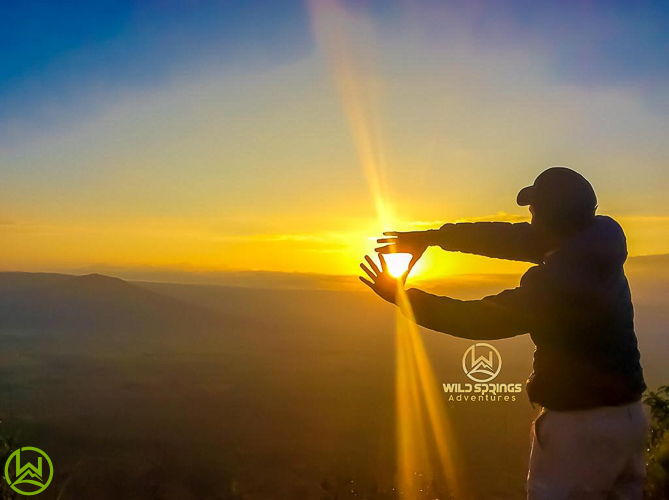
This is the image people keep. The light over the Rift Valley at this elevation, at this time, in this direction — Lake Naivasha catching orange and the escarpment going dark behind it — is one of the best sunset viewpoints accessible within a 2-hour drive of Nairobi.
17:30 — Crater Descent
The guide leads the descent from the rim to the crater floor. This is the part the porter team and your guide have prepared for since the morning. The terrain is steep, unmarked, and requires your full concentration. Trekking poles essential. Follow the guide's line exactly. Allow 45 to 90 minutes.
When you reach the crater floor and the rim disappears above you, the scale of what you are inside becomes very clear.
Camp Setup
The porter team has scouted the site and is ahead of you. By arrival, the kitchen is operational, tents are pitched, and the firebreak is established. In the crater, the night is very dark — no road light, no settlement light, no airport light reaches the floor. The steam vents hiss quietly from the far walls.
Dinner around the bonfire. Stargazing from inside a volcano. The absence of light pollution in the crater is complete. The Milky Way is visible on clear nights in a way that cannot be experienced from anywhere inside Nairobi or its immediate environs.
🍽️ Day 1 Meals: Lunch (en route or at gate) · Dinner at crater camp 🏕️ Overnight: Crater floor, Mount Longonot
🌅 Day 2 — Sunrise, Steam, and Return to Nairobi
04:30 — Wake-up. Hot drink at camp.
The steam vents that were hissing through the night become visible in the pre-dawn cold. In still conditions, the geothermal steam rises and pools above the crater floor — the famous "shimmering lake" illusion that appears in photographs of Longonot sunrise from the rim. From inside the crater, you are below the steam. This is a different perspective.
05:00 — Crater Exit Ascent
The climb from the crater floor back to the rim is physically shorter than the crater descent but requires full effort. The guide goes first. The steep volcanic terrain is particularly demanding in the early morning when muscles are cold. Allow 60 to 90 minutes.
06:30 — Sunrise from the Rim
If the timing works, you are on the rim as the sun breaks over the eastern escarpment. The steam below you catches the light. Lake Naivasha turns pink. The crater floor, where you slept, is now below a layer of geothermal mist. This is the photograph.
07:30 — Breakfast at the Rim
Hot breakfast prepared by the cook team, who have ascended with the kitchen equipment. Eat here. Look at both views — the valley and the crater below. Then descend.
09:00 — Descent to Gate
The standard trail descent. Faster than the ascent. Still demanding on the knees on the steeper volcanic sections.
10:30 — Gate
Sign out at KWS. Vehicle waiting. Drive to Naivasha town for final refreshments on request.
12:30 — Nairobi
🍽️ Day 2 Meals: Breakfast at the rim · Packed snack for descent
🐾 Wildlife Inside Mount Longonot
Mount Longonot's enclosed ecosystem concentrates wildlife in ways that larger open parks cannot. The Rift Valley floor below the mountain holds larger herds. Inside the crater, the wildlife is more intimate.
| 🐾 Species | 👁️ Likelihood | 📍 Where | Note |
|---|---|---|---|
| 🦓 Plains Zebra | ★★★★★ | Lower slopes, park road | Herds visible from the trail gate to rim |
| 🦒 Reticulated Giraffe | ★★★★☆ | Lower acacia scrubland | Often visible from the trail in the lower section |
| 🐃 Cape Buffalo | ★★★★☆ | Lower park and rim approaches | Active — move in groups |
| 🦌 Eland and Hartebeest | ★★★☆☆ | Open grassland sections | Africa's largest antelope, regularly sighted |
| 🦒 Grant's Gazelle | ★★★★☆ | Open areas throughout | Common on Longonot's lower slopes |
| 🐆 African Leopard | ★☆☆☆☆ | Crater forest | Reported inside the crater forest — very rare, very significant |
| 🐒 Olive Baboon | ★★★★☆ | Rock faces and rim | Groups regularly on the crater rim |
| 🦁 Lion | ★★☆☆☆ | Open parkland | Present in the park — unlikely sighting |
Birds of prey at the rim: Verreaux's Eagle (Aquila verreauxii) and the Lammergeier (Bearded Vulture) (Gypaetus barbatus) are recorded soaring the thermal columns above the crater rim — two of Kenya's most impressive raptors in one viewpoint.
🌿 The Crater Forest
The thick forest covering the crater floor is one of Mount Longonot's most surprising features. Viewed from the rim, it appears like a hidden garden — improbably lush inside a volcano. This forest is the primary wildlife habitat inside the crater, sheltering species that are rarely seen on the exposed outer slopes.
The forest creates its own microclimate — cooler, moister, and sheltered from the Rift Valley winds by the crater walls on all sides. This is where the leopard reports originate. The forest is real enough and dense enough that a leopard could live undisturbed by the day hikers who never descend into it.
You will be camping at the edge of this forest tonight.
💰 2026 Pricing - Mount Longonot Crater Camping
Why this tour is priced at this level — transparent breakdown:
| Cost Component | Notes |
|---|---|
| KWS park entry — 2 days | Non-resident $80/day · EAC KES 1,000/day |
| KWS special campsite permit | Largest single cost · Advance reservation · Exclusive use · Non-refundable |
| Porter team — at guide association rates | Higher than standard portage — unmarked terrain, heavy water load |
| Guide — crater descent specialist | Experienced guides specifically — no standard guides on this tour |
| All meals (5 meals across 2 days) | Cooked at altitude from porterd ingredients |
| All water (porterd to crater floor) | 4–6 litres per person per night plus cooking |
| Camping equipment (tents, mattresses, sleeping mats) | Carried by porter team |
| Firewood | Porterd to crater |
| First aid and emergency response | Standard |
| Evacuation cover can be arranged on request at additional cost | Both days |
This is not a standard camping markup. Every line item above is a real cost that does not exist on standard campsite experiences.
| 👥 Group Size | 🇰🇪 Kenyan Citizens (KES) | 🌍 EAC Residents (KES) | 🌐 Non-Residents (USD) |
|---|---|---|---|
| 1 Person (solo, with transport) | KES 52,000 | KES 58,000 | $420 |
| 1 Person (solo, self-drive) | KES 44,000 | KES 50,000 | $360 |
| 2–3 Persons (pp, with transport) | KES 36,000 | KES 42,000 | $280 |
| 2–3 Persons (pp, self-drive) | KES 30,000 | KES 36,000 | $235 |
| 4–6 Persons (pp, with transport) | KES 28,000 | KES 34,000 | $215 |
| 4–6 Persons (pp, self-drive) | KES 22,000 | KES 28,000 | $180 |
📌 Deposit: 50% confirms booking (the KWS advance permit is paid from it straight away and cannot be refunded)
📌 Cancellation: Full refund minus KWS campsite permit cost with 14 days notice
📌 Advance booking required: Minimum 7 days before your date — KWS permit must be confirmed
📌 Self-drive: Safe car parking at the gate. GPS: -0.9186, 36.4502. Vehicle is secure overnight.
Payment details are sent with your written invoice.
✅ What Is Included
- ✔ 🎫 KWS Mount Longonot National Park entry fees — both days
- ✔ 📋 KWS special campsite reservation — exclusive use, advance booking
- ✔ 🧭 KPSGA-certified guide — crater descent specialist
- ✔ 🏋️ Full porter team — water, tents, cooking equipment, food, firewood carried to crater
- ✔ ⛺ Expedition tents and sleeping mattresses
- ✔ 🍽️ All meals — lunch Day 1 · dinner at crater · breakfast at rim (5 meals total)
- ✔ 💧 All water — approximately 5 litres per person per night, portered to the crater
- ✔ 🔥 Firewood for bonfire at crater camp
- ✔ 🩺 Emergency first aid kit
- 🚁 Evacuation cover can be arranged on request at additional cost
- ✔ 🚐 Nairobi return transport (if transport option selected)
❌ What Is Not Included
- ✗ Sleeping bag — critical, bring your own · nights in the crater reach 8–12°C · minimum 0°C rated bag
- ✗ Personal hiking gear — trekking boots, poles, headtorch, warm layers
- ✗ Travel insurance — mandatory, must cover high-altitude adventure activities
- ✗ Nairobi transport (if self-drive option selected)
- ✗ Tips for guide and porter team — strongly encouraged · ask us for suggested amounts
- ✗ Alcoholic beverages
⚠️ Safety - What You Need to Know Before the Crater Descent
The crater rim trail is eroded and demanding. Parts of the 3.1km ascent to the rim are steep enough to require hands. Volcanic dust creates a slippery surface on sections. This is not a walk. It is a serious hike.
The crater descent is unmarked. The trail from the rim to the crater floor is not maintained. Your guide selects the descent line based on current conditions. You follow exactly. Trekking poles are not optional on this section — they are essential.
There is no rescue infrastructure inside the crater. If someone is injured on the crater floor, extraction requires your guide team to manage the situation and arrange evacuation. Evacuation cover can be arranged on request at additional cost. We have emergency communication equipment on every crater camping trip. This is why we do not run this tour with inexperienced guides.
Altitude at 2,776m is real. Longonot is not at extreme altitude but the combination of exertion, heat on the lower slopes, and the crater night temperature creates physical demands on the body. Hydrate throughout. Eat before the descent. Bring more layers than you think you need.
Minimum fitness requirement: You must be able to hike 13km of mountain terrain in a single day and manage a steep unmarked descent on volcanic rock. No medical conditions affecting cardiovascular output or balance. If you are uncertain, contact us before booking.
🎒 What to Bring
Non-negotiable:
- 🥾 Ankle-support hiking boots with grip soles — volcanic terrain
- 🧗 Trekking poles — both descent sections reward them significantly
- 🔦 Headtorch — crater darkness is complete
- 🌡️ Sleeping bag rated to 0°C minimum — crater floor reaches 8–12°C overnight
- 🧥 Warm fleece and windproof shell — the rim wind at dawn is cold
- 🧤 Gloves — summit ridge and pre-dawn crater exit
- 💧 Personal water bottle 1.5L+ — we provide water but you carry your supply
Strongly recommended:
- 👖 Long trousers — volcanic dust and the crater descent
- ☀️ Sunscreen SPF 50+ — the lower slopes are exposed and UV is intense
- 📱 Camera or phone with good low-light capability — crater stargazing and steam sunrise
🏪 All gear available at the Wild Springs Outdoor Store.
📅 Best Time for Crater Camping
| Month | Trail Condition | Crater Night Temp | Sky Clarity |
|---|---|---|---|
| January–March | ⭐⭐⭐⭐⭐ Ideal | 10–14°C | ⭐⭐⭐⭐⭐ |
| April–May | ⭐⭐ Avoid | 12–16°C | ⭐⭐ Cloud |
| June–August | ⭐⭐⭐⭐⭐ Ideal | 8–12°C | ⭐⭐⭐⭐⭐ |
| September–October | ⭐⭐⭐⭐ Good | 10–14°C | ⭐⭐⭐⭐ |
| November | ⭐⭐⭐ Variable | 12–16°C | ⭐⭐⭐ |
| December | ⭐⭐⭐⭐ Good from mid-month | 10–14°C | ⭐⭐⭐⭐ |
Stargazing note: June–August gives the coldest crater temperatures and the clearest skies. The Milky Way core is most visible in this window. If the stargazing experience is a primary reason you are booking, July and August are the optimal months.
Avoid April and May. The long rains make the volcanic descent extremely slippery and the crater floor waterlogged. We do not run crater camping during the long rains.
🌿 Leave No Trace - KWS Rules
Mount Longonot National Park is a KWS-managed protected area. The special campsite designation comes with strict environmental conditions.
- 🗑️ All waste exits the crater with the porter team. Nothing is buried. Nothing is burned beyond the designated fire area. Nothing is left.
- 💧 No soap, detergent, or food waste within 60 metres of any vegetation or rock feature
- 🌿 No rocks, plants, or geological samples removed from the park
- 🔥 Fire is contained to the designated fire area — the porter team manages this
- 📢 No amplified sound after 22:00 — the crater is a wildlife habitat at night
- 🐆 Do not approach or follow wildlife — the crater forest wildlife is wild and unhabituated
Wild Springs reads these conditions aloud at the Day 1 gate briefing. Every participant is responsible for upholding them.
🔗 What to Do Next - The Rift Valley Circuit
Longonot is the centrepiece of one of Kenya's best weekend circuits:
| Experience | Notes |
|---|---|
| 🦩 Lake Naivasha Boat Safari | Hippos and birds — 20 minutes from Longonot gate |
| 🌋 Hell's Gate Cycling and Hike | Gorges, geysers, wildlife on foot — 30 minutes from Longonot |
| 🦁 Masai Mara Group Safari | Complete the Rift Valley with the Big Five |
| 🌋 Mount Longonot Day Hike | Day version — rim only, no crater descent · for those who want Longonot without overnight |
📞 Book Your Crater Camping Expedition
Minimum 7 days advance booking required. Peak dates (July–October weekends) book 3 weeks ahead.
📱 WhatsApp: +254 729 257 317 · +254 734 417 496
Tell us your preferred date, group size, and whether you need Nairobi transport. We confirm guide team and KWS permit availability within 24 hours. 🌋
🌍 For Our International Guests
🇩🇪 Deutsch: Kraternacht auf dem Mount Longonot — schlafen Sie auf dem Boden eines aktiven Vulkans, 60 km von Nairobi. Exklusiver KWS-Sondercampingplatz im Krater, Trägerteam trägt Wasser und Ausrüstung hinunter, unbefestigter Abstieg, Fumarolen bis 104°C und sternenklarer Himmel ohne Lichtverschmutzung. Reine Abenteuererfahrung. Ab KES 22.000 pp (Gruppe, eigene Anreise). WhatsApp: +254 729 257 317 · Österreich: +43 650 702 1313
🇫🇷 Français: Nuit dans le cratère du Mont Longonot — dormez au fond d'un volcan actif à 60 km de Nairobi. Permis de camping spécial KWS exclusif, équipe de porteurs transportant l'eau et le matériel, descente non balisée, fumerolles jusqu'à 104°C et ciel étoilé sans pollution lumineuse. Expérience réservée aux vrais aventuriers. À partir de KES 22.000 pp (groupe, transport propre). WhatsApp : +254 729 257 317
🇪🇸 Español: Noche en el cráter del Monte Longonot — duerma en el fondo de un volcán activo a 60 km de Nairobi. Permiso de camping especial KWS exclusivo, equipo de porteadores transportando agua y equipo, descenso no señalizado, fumarolas hasta 104°C y cielo estrellado sin contaminación lumínica. Experiencia solo para verdaderos aventureros. Desde KES 22.000 pp (grupo, transporte propio). WhatsApp: +254 729 257 317
We never request payment through social media, personal phone numbers, or any account or link not confirmed in writing by our office. If in doubt, call us before paying anyone.
Where You Will Visit
This trek explores the following regions in Kenya
- Naivasha, Nakuru County