7-Day Mount Kenya Traverse: Sirimon Up, Hall Tarns & Lake Michaelson, Naro Moru Down 🏔️
Trek at a Glance
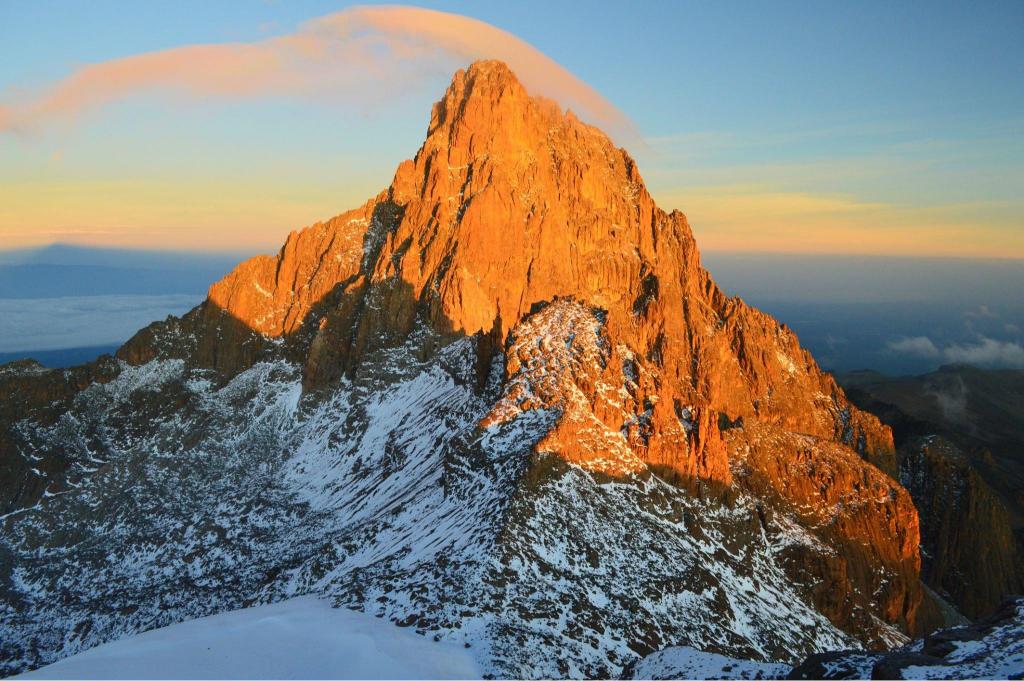
Cross Mount Kenya from one side to the other, with time to acclimatise. This 7-day traverse climbs the Sirimon route through the Sirimon Valley to the Hall Tarns, spends a full day walking down to Lake Michaelson in the Gorges Valley and back, reaches Point Lenana (4,985 m) for sunrise, and comes down the Naro Moru side. It runs as a private or small-group departure on dates you choose, for groups of up to 8.
⭐ Key takeaways
- Route: Sirimon up → Sirimon Valley → Hall Tarns → Point Lenana → Naro Moru down. Up one side of the mountain, down the other.
- Duration: 7 days, six of them on foot: 60 km, 2,685 m of ascent and 2,935 m of descent.
- The difference: two nights at Hall Tarns (4,300 m), with a full acclimatisation day between them. It is not a rest day.
- Summit: Point Lenana (4,985 m), the trekking summit, at sunrise. No technical climbing.
- The hard part: Day 6, about 14 hours, with almost two vertical kilometres of descent. Trekking poles are not optional.
- Price: from USD 1,620 per person (non-residents, based on a full group of 8).
- Operator: Wild Springs Adventures, Nairobi. TRA-licensed, a TOSK member, with KWS-certified mountain crew.
🧭 The traverse at a glance
| Feature | Details |
|---|---|
| 📅 Duration | 7 days / 6 nights, six days on foot |
| 🛤️ Route | Sirimon up, Naro Moru down, via the Sirimon Valley and the Hall Tarns |
| 🚩 Summit | Point Lenana, 4,985 m, at sunrise |
| 🏕️ Highest camp | Hall Tarns, 4,300 m, for two nights (the maximum sleeping altitude) |
| 📏 Distance | 60 km on foot |
| ⛰️ Ascent / descent | +2,685 m / −2,935 m |
| 👣 Difficulty | Non-technical but demanding: long days at altitude and one day of about 14 hours |
| 🛏️ Accommodation | One night at Naro Moru River Lodge (full board), then five nights in high-altitude tents |
| 🔒 Style | Private or small-group departure on dates you choose |
| 👥 Group size | Groups of up to 8 |
| 📍 Start / end | Nairobi: collection from Jomo Kenyatta International Airport or your Nairobi hotel, and drop-off at either |
| 🌦️ Best months | The two dry seasons, roughly January–March and late June–October |
| 💰 Price | From USD 1,620 per person (non-residents, based on a full group of 8) |
✨ Why this route?
This traverse is built around one idea: give your body time at altitude before summit night, and spend that time somewhere worth seeing.
- 🔁 Two sides of the mountain. You climb the Sirimon side and come down the Naro Moru side.
- 🫁 A gentler altitude profile. You sleep at 3,300 m, 3,940 m, then 4,300 m twice. Two moderate gains, then a full day at 4,300 m before the summit. That is gentler than shorter 4- and 5-day itineraries.
- 💎 Lake Michaelson as a day walk. On Day 5 you drop into the Gorges Valley to Lake Michaelson, The Temple and Vivienne Falls, then climb back to the same camp.
- 🌅 A summit start from a camp you know. You leave for Point Lenana from Hall Tarns after two nights there, not on your first night at that height.
- 🛏️ A lodge night first. Day 1 ends at Naro Moru River Lodge (1,970 m), full board. You start walking on Day 2, not straight off the road from Nairobi.
Prefer to join a scheduled group with guaranteed departures? See our Mount Kenya Group Treks (Guaranteed Departures).
🎯 Is this trek right for you?
This traverse suits you if you:
- Want time to acclimatise, not the quickest way to the top.
- Can walk five to six hours on consecutive days, and are ready for one very long day.
- Are happy in a tent for five nights, two of them at Hall Tarns, where nights are well below freezing.
- Want to see two sides of the mountain and the Gorges Valley on one trip.
Point Lenana needs no ropes or climbing skills. You do need to arrive fit. If you have knee trouble, have had problems at altitude before, or have any medical matter we should know about, tell us when you book. It changes how we staff summit day, not the price.
🗓️ Day-by-day itinerary
🚐 Day 1 — Nairobi → Naro Moru · by road · sleep at 1,970 m
We collect you from Jomo Kenyatta International Airport or your Nairobi hotel and drive to Naro Moru. The night is at Naro Moru River Lodge, full board. There is no walking today. Repack for the mountain and get an early night.
By road · Overnight: Naro Moru River Lodge, 1,970 m, full board.
🥾 Day 2 — Sirimon Gate → Judmeier Camp (Old Moses) · 9 km · ~3 h · +650 m · sleep at 3,300 m
After breakfast, drive to Sirimon Gate (2,650 m) and register with the park. The first walk is short: 9 km and 650 m of gain, about three hours, to Judmeier Camp, also known as Old Moses. From here you sleep in high-altitude tents.
Walk slowly from the first step. Today sets the pace for the week.
🌿 Day 3 — Judmeier → Sirimon Valley camp · 8 km · 5–6 h · +640 m · sleep at 3,940 m
A similar gain to yesterday, 640 m, over a longer day: 8 km and five to six hours to camp in the Sirimon Valley at 3,940 m. Your guide keeps the pace slow on purpose. Arrive with energy to spare, drink steadily and eat well.
🏕️ Day 4 — Sirimon Valley → Hall Tarns · 9 km · 5–6 h · +360 m · sleep at 4,300 m
A smaller gain, 360 m, spread over 9 km and five to six hours, brings you to the Hall Tarns at 4,300 m. This is your highest camp, and you stay two nights. Nights here are well below freezing, which is why we ask for a sleeping bag rated −15 °C comfort.
💎 Day 5 — Acclimatisation day: Lake Michaelson and the Gorges Valley · ~7 km · ~6 h · −350 m / +350 m · sleep at 4,300 m
This is not a rest day. You descend 350 m into the Gorges Valley to Lake Michaelson, the rock formation known as The Temple, and Vivienne Falls. Then you climb the 350 m back up to camp. About 7 km and six hours.
It is the finest day on the mountain. It is also the main reason groups summit: a full, active day, then a second night at 4,300 m before the summit push.
Overnight: Hall Tarns, 4,300 m, same camp. More on the lake: Lake Michaelson.
🌄 Day 6 — Point Lenana (4,985 m) at sunrise → Met Station · 18 km · ~14 h incl. breaks · +685 m / −1,935 m · sleep at 3,050 m
You leave camp at 03:00 by headtorch and climb 685 m to Point Lenana (4,985 m) for sunrise. Then comes the long descent: 1,935 m down to the Met Station (3,050 m). In all, 18 km and about 14 hours, breaks included.
This is the hardest day of the trek: almost two vertical kilometres of descent on tired legs. Trekking poles are not optional. With larger groups we run a lead guide and an assistant guide and split into two pace groups for the summit push, so nobody is dragged along and nobody who turns back takes the rest with them.
🏁 Day 7 — Met Station → Naro Moru Gate → Nairobi · 9 km · ~3 h on foot · −650 m
A last 9 km on foot, about three hours and 650 m down, to Naro Moru Gate. You are off the mountain by mid-morning. Say goodbye to your crew, then drive back to Nairobi. Drop-off at the airport or your Nairobi hotel is at no extra cost.
Trip ends in Nairobi. Lunch on the drive back is not included.
🫁 Altitude profile and acclimatisation
Altitude, not fitness alone, is what turns trekkers back on Mount Kenya. So this itinerary is built around where you sleep.
| Day | Sleep at | Sleeping altitude | Gain / loss on foot |
|---|---|---|---|
| 1 | Naro Moru River Lodge | 1,970 m | — (by road) |
| 2 | Judmeier Camp (Old Moses) | 3,300 m | +650 m |
| 3 | Sirimon Valley camp | 3,940 m | +640 m |
| 4 | Hall Tarns | 4,300 m | +360 m |
| 5 | Hall Tarns (same camp) | 4,300 m | −350 m / +350 m |
| 6 | Met Station, via Point Lenana (4,985 m) | 3,050 m | +685 m / −1,935 m |
| 7 | — (trip ends in Nairobi) | — | −650 m |
| Total | Six days on foot, 60 km | — | +2,685 m / −2,935 m |
On the mountain you sleep at 3,300 m, 3,940 m, 4,300 m, 4,300 m and 3,050 m. That is two moderate gains, then a full day at 4,300 m before the summit: a gentler profile than shorter 4- and 5-day itineraries.
Drink plenty of water. Eat even when you are not hungry. Walk slowly. Tell your guide early about any headache or nausea. Every trekker gets a pulse-oximeter check every morning and evening, at every camp.
🌄 Summit day: what to expect
- 03:00: leave Hall Tarns by headtorch.
- Sunrise: Point Lenana, 4,985 m, after 685 m of climbing.
- The descent: 1,935 m down to the Met Station, 3,050 m.
- In all: 18 km and about 14 hours, breaks included.
The climb is the part people worry about. The descent is the part that hurts: almost two vertical kilometres on tired legs. Trekking poles are not optional. Keep spare headtorch batteries warm inside your jacket. Mount Kenya makes its own weather, and your guide makes the final summit call based on conditions, for your safety.
⛑️ Safety on the mountain
- 🩺 Pulse-oximeter checks for every trekker, every morning and evening, at every camp.
- 🧰 First aid: your guides carry comprehensive first-aid kits.
- 🚑 Mountain rescue coordination is included.
- ⬇️ Descent first: any trekker showing serious symptoms descends immediately — no exceptions and no debate — and a guide or porter comes down with them at no extra cost to you.
- 🫁 Bottled oxygen is not included as standard. A cylinder can be carried; it is quoted separately on request.
- 📋 Tell us when you book about knee trouble, altitude history or any medical matter. It changes how we staff summit day, not the price.
Air evacuation cover is not included in your trek price. We can arrange AMREF Flying Doctors evacuation cover on request at additional cost — tell us when you book. Travel and medical insurance is mandatory: see the insurance section below.
🌦️ Best time to go
Mount Kenya has two dry seasons: roughly January to March and late June to October. They bring the clearest skies and the most stable trails. The wetter months, April to May and November, mean muddier trails and a real need for waterproofs.
In any season the mountain makes its own weather, and mornings are usually the clearest part of the day. That is one reason summit day starts at 03:00. For a month-by-month view, see our guide to the best months to climb Mount Kenya.
💰 Price (per person)
From USD 1,620 per person (non-residents, based on a full group of 8).
Prices for smaller groups, and KES prices for Kenyan citizens and residents, are on request. Kenya Wildlife Service charges citizens and residents lower park fees, so their prices are quoted in Kenya shillings. Carry the matching ID (passport, resident card or national ID) for registration at the park gate.
Our Mount Kenya climbing cost guide explains where the money goes.
✅ What's included
- 🎟️ All park and camping fees
- 🧭 KWS-certified mountain guides: a lead guide, plus an assistant guide with larger groups
- 🍲 A mountain chef, and all meals on the mountain
- 🎒 Porters
- ⛺ High-altitude tents
- 🏨 One night at Naro Moru River Lodge, full board
- 🚐 Transfers both ways: collection from Jomo Kenyatta International Airport or your Nairobi hotel on Day 1, and on Day 7 the drive to the airport or your Nairobi hotel
- 🩺 Pulse-oximeter monitoring, every morning and evening at every camp
- 🚑 Mountain rescue coordination
❌ What's not included
- ✈️ International flights and the Kenya eTA
- 🏙️ Nairobi hotel nights before or after the trek
- 🚕 Extra Nairobi transfers on non-trek days (quoted separately)
- 🛡️ Travel and medical insurance — mandatory, see below
- 🚁 Air evacuation cover — arranged on request at additional cost
- 🛌 Sleeping bag — hire in Nairobi from KES 1,000 per day
- 🫁 Bottled oxygen — quoted on request
- 🥪 Lunch on the drive back on Day 7
- 🍺 Drinks and personal expenses
- 🥾 Personal clothing and trekking kit — see the kit essentials below
- 💵 Crew tips — at your discretion
About tips. Hand them to the lead guide at the end of the climb, in shillings or dollars, and they are shared across the team. Our tipping guide explains the local context.
🎒 Kit essentials
- Sleeping bag rated −15 °C comfort. A bag's limit rating is colder than its comfort rating, so buy or hire by the comfort figure. Nights at Hall Tarns are well below freezing. It is not included in the price: hire one in Nairobi from KES 1,000 per day.
- Trekking poles. Not optional. Day 6 drops 1,935 m on tired legs.
- A headtorch and spare batteries. Summit day starts at 03:00.
- Warm layers. Thermal base layers, a fleece, an insulated down or synthetic jacket, a warm hat and gloves. A fleece alone is not enough on summit morning.
- Waterproof boots with ankle support, worn in before you travel, plus a waterproof jacket and trousers.
Our outdoor gear store in Parklands, Nairobi stocks all of it — new, gently used and for hire. The full Mount Kenya gear checklist is on our blog.
🏃 Fitness and preparation
Start training two to three months ahead.
- Build an aerobic base: three to four sessions a week of brisk walking, jogging, cycling or swimming.
- Train with a loaded daypack on hills and stairs.
- Strengthen legs and core (squats, lunges, step-ups) to protect your knees on the long descent.
- Practise back-to-back days: a long walk two days running teaches your body to recover and keep going.
- Break in your boots and test your warm layers before you travel.
📝 Booking terms
Deposit: 50% of the trip price confirms your place, and it is fully applied to your balance.
Balance: due 14 days before departure.
Cancellation: more than 45 days before departure, bank charges only, up to USD 40; 22 to 45 days, 25%; 8 to 21 days, 50%; 3 to 7 days, 85%; within 72 hours, 100%.
Changing dates: free when you move your dates more than 14 days before departure.
Group size: groups of up to 8.
Quotations: a quotation we have already issued stands as issued.
Your booking is covered by our terms and conditions and cancellation policy. The details you give us when booking — including any medical information you share with your guide — are handled as set out in our privacy policy.
🛡️ Insurance: two separate requirements
Two separate requirements apply, and you need both.
Kenya's entry rule. Non-Kenyan visitors staying under 12 months must hold travel health insurance with combined benefits of at least USD 50,000, covering medical treatment, emergency medical transport, prescribed medicines, mental health care and repatriation. The cover can be bought with the eTA application or through the government's eCitizen insurance portal. Whether a policy from your own country is accepted instead is still being settled, so check the current rule on Kenya's official eTA portal before you travel.
Our requirement on top of that. Your policy must cover trekking to 5,000 m and emergency evacuation. Many standard travel policies exclude altitude above 3,000 or 4,000 m, and that is the exclusion that matters on Point Lenana. Check it before you buy, not after.
Buy your insurance when you book, not when you travel — cancellation cover only pays out if the policy was already in force when the reason to cancel arose.
💳 How to pay
These are the payment methods we accept. Our M-Pesa paybill is 4065921, in the name of Wild Springs Adventures, and we never ask you to pay M-Pesa to any other number. We do not publish payment links. Once we confirm your place, we send you a written invoice from our office. Payment details are sent with your written invoice.
| Method | Currency | Best for |
|---|---|---|
| 📱 M-Pesa | KES | Kenyan citizens and residents, and visitors with a Kenyan line |
| 🏦 Local bank transfer | KES | Kenyan bank account holders and corporate bookings |
| 🌍 International bank transfer (SWIFT) | USD, EUR, GBP | Overseas visitors paying a full balance |
| 💳 Visa or Mastercard | USD, KES | Anyone. A secure card link is issued with your invoice. |
| 🅿️ PayPal | USD, EUR | Overseas visitors who prefer buyer protection |
| 💵 Cash at our Nairobi office | KES, USD | Walk-in bookings and balance settlement before departure |
Bank charges on international transfers are paid by the sender. Card and PayPal payments may carry a processing fee, which we tell you before you pay, never after. Deposits and balances can be paid by different methods — there is no requirement to use the same one twice.
🏅 Why climb with Wild Springs Adventures?
- 📋 TRA Licensed — licence number TRA1/47/C01/25895, searchable on the Tourism Regulatory Authority register.
- 🤝 TOSK Member #0082 — Tour Operators Society of Kenya directory.
- 🏆 TripAdvisor Travellers' Choice 2024, 2025 and 2026 — read the reviews.
- ✅ KWS-certified mountain guides — certificate numbers available on request.
- 🏪 Our own outdoor gear store in Parklands, Nairobi.
- 📅 On Mount Kenya since 2013 — across every route, in every season.
❓ Frequently asked questions
Is the acclimatisation day a rest day?
No. On Day 5 you walk about 7 km in about six hours. You drop 350 m into the Gorges Valley to Lake Michaelson, The Temple and Vivienne Falls, then climb 350 m back to the same camp at Hall Tarns. It is the finest day on the mountain, and the main reason groups summit.
How hard is summit day?
It is the hardest day of the trek: 18 km and about 14 hours, breaks included, from a 03:00 start by headtorch. After 685 m up to Point Lenana (4,985 m) comes 1,935 m down to the Met Station (3,050 m), on tired legs. Trekking poles are not optional.
Can we do it in fewer days?
Yes, on a different itinerary. Our Mount Kenya Group Treks page lists shorter routes, and our 6-day Chogoria private trek is a day shorter. What you give up is time at altitude: this profile is gentler than shorter 4- and 5-day itineraries. If you have the days, take them.
Where do we sleep?
The first night is at Naro Moru River Lodge (1,970 m), full board. From Day 2 you sleep in high-altitude tents: Judmeier Camp (Old Moses) at 3,300 m, the Sirimon Valley camp at 3,940 m, Hall Tarns at 4,300 m for two nights, and the Met Station at 3,050 m. Tents are included. Your sleeping bag is not.
Is this a private trek?
It runs as a private or small-group departure on dates you choose, for groups of up to 8. The price shown is based on a full group of 8; prices for smaller groups are on request. To join a scheduled departure with other trekkers instead, see our Mount Kenya Group Treks.
Can Kenyan citizens and residents book?
Yes. Kenya Wildlife Service charges citizens and residents lower park fees, so we quote your price in Kenya shillings, on request. Carry your national ID or resident card for registration at the park gate.
What sleeping bag do I need?
One rated −15 °C comfort. Go by the comfort figure, not the limit, because nights at Hall Tarns are well below freezing. Sleeping bags are not included in the price. You can hire one in Nairobi from KES 1,000 per day.
What if someone cannot continue on summit day?
Your guide makes the call, and going down comes first. Any trekker showing serious symptoms descends immediately, and a guide or porter comes down with them at no extra cost to you. With larger groups we run a lead guide and an assistant guide and split into two pace groups for the summit push, so nobody is dragged along and nobody who turns back takes the rest with them.
📩 Book this traverse
Tell us your preferred dates and group size. We confirm availability and the arrangements in writing before you pay anything.
- 📱 WhatsApp / Call: +254 729 257 317 · +254 721 957 652
- 📧 Email: [email protected] · [email protected]
- 📬 Enquire and book
- ✅ TRA Licensed No. TRA1/47/C01/25895 · 🏛️ TOSK Member #0082
- 🌐 More treks: Mount Kenya Group Treks · 6-Day Chogoria Private Trek · Lakes and Tarns Expedition
Booking and payment stay with our office in Nairobi.
We never request payment through social media, personal phone numbers, or any account or link not confirmed in writing by our office. If in doubt, call us before paying anyone.
Where You Will Visit
This trek explores the following regions in Kenya
- Nanyuki