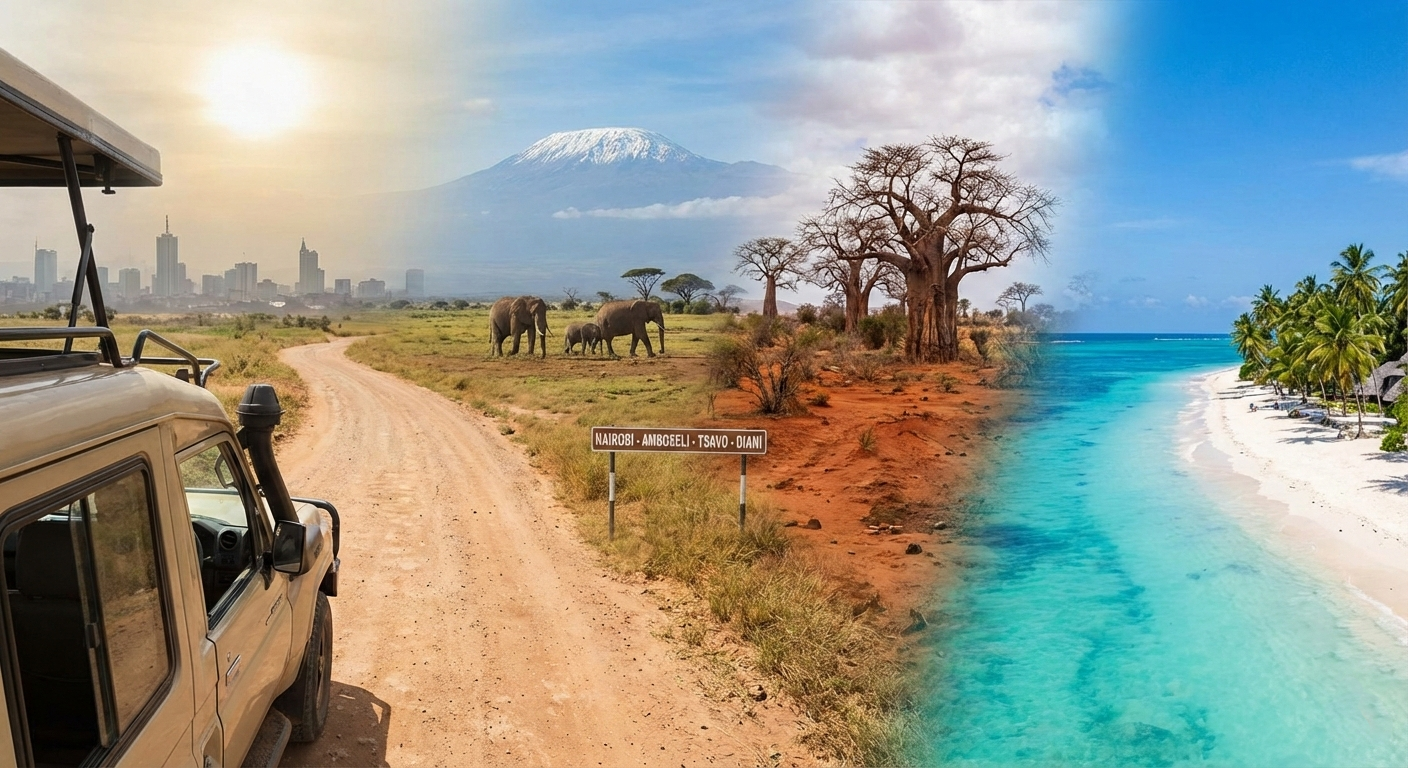
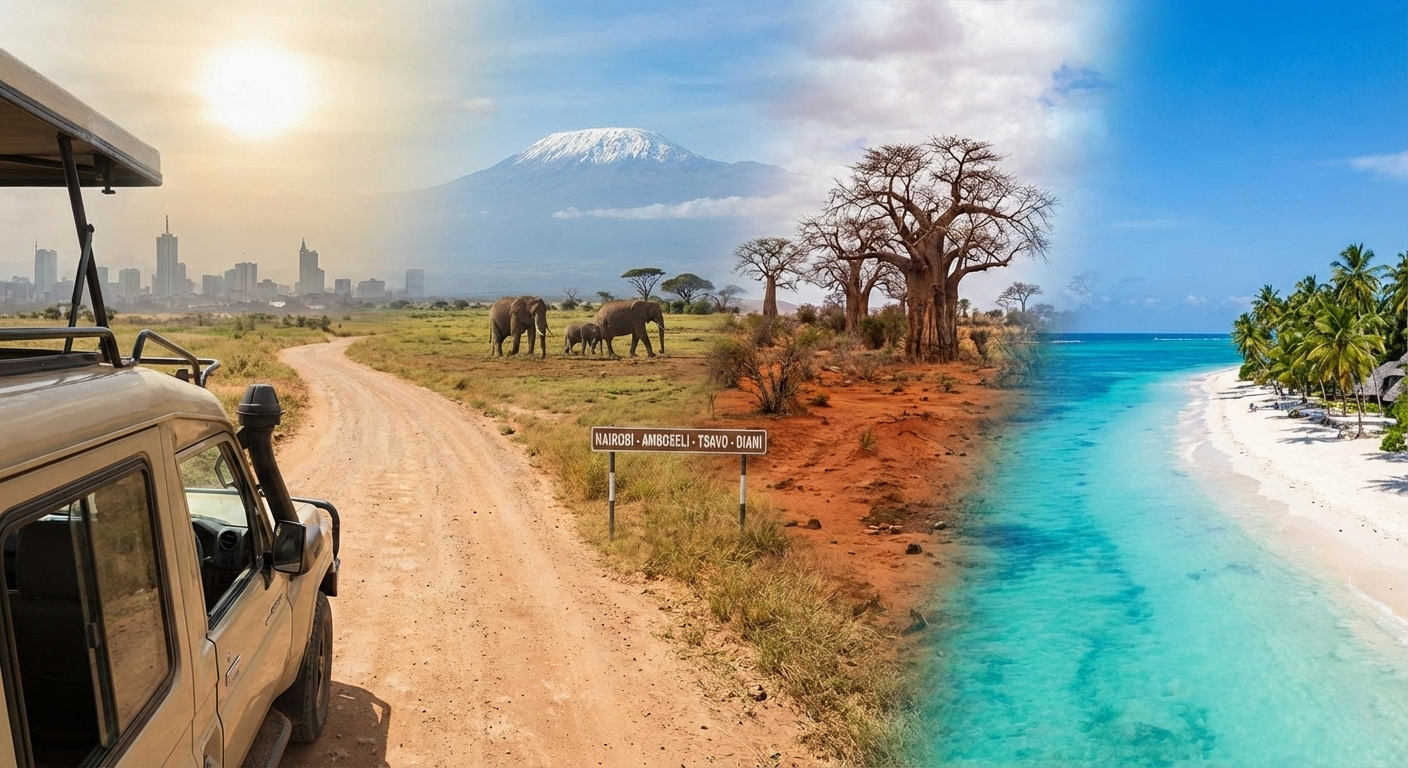
4-Day Nairobi To Diani Safari Via Amboseli & Tsavo 2026
Safari at a Glance
Wild Springs Adventures · Nairobi-Based Kenya Safari Specialists Since 2013
🏆 TripAdvisor Travelers' Choice 2024, 2025 and 2026 · ✅ TRA Licensed No. TRA1/47/C01/25895 · 🏛️ TOSK Member #0082
🌍 Overview — Kenya's Most Complete Safari and Beach Itinerary
The Nairobi to Diani safari via Amboseli and Tsavo is the most ecologically diverse overland journey available from any East African city in four days. No other itinerary in Kenya moves you through as many distinct landscapes — from Nairobi's highland plateau, south across the Athi Plains into Amboseli's alkaline basin with Kilimanjaro rising behind its 1,600-strong elephant herds, west into the volcanic drama of Tsavo West with its underground rivers and youngest lava fields in Africa, through the red-dust elephant country of Tsavo East, and finally onto the white coral sand of Diani Beach and the Indian Ocean.
This bush-to-beach safari Kenya route became possible in its current form with the opening of the Madaraka Express Standard Gauge Railway, which ends the historical problem of the exhausting 8-hour road transfer from Tsavo to Mombasa and replaces it with a 4.5-hour first-class train journey through one of Africa's most significant railway corridors. The train does not just solve a logistics problem. It adds a fourth dimension to the safari — a colonial-era journey reborn in modern form through the landscape that Denys Finch Hatton once crossed by light aircraft to reach his camp at the foot of the Chyulu Hills.
This is Kenya at its most layered — wildlife, geology, literary history, birding, and beach — in a single south-to-coast journey that remains one of the most requested itineraries Wild Springs Adventures operates. It is also available as a circular Amboseli and Tsavo safari from Nairobi — returning to Nairobi without the beach — for clients whose flights do not include the coast. Both versions are fully described below.
📋Bush-to-beach safari Kenya at a Glance
| Feature | Details |
|---|---|
| 🗺️ Route Option A | Nairobi → Amboseli → Tsavo West → Tsavo East → Madaraka Express → Diani Beach |
| 🗺️ Route Option B | Nairobi → Tsavo East → Tsavo West → Amboseli → Nairobi (circular — no beach) |
| 📅 Duration | 4 Days / 3 Nights |
| 🚐 Transport | Private 4×4 Land Cruiser or Safari Van + Madaraka Express SGR first class |
| 🎒 Style | Private guided safari — exclusive to your group |
| 👥 Best For | Couples · Honeymooners · Families · Photographers · Birders · Literary history enthusiasts |
| 🐘 Key Wildlife | Elephants · Lions · Rhino · Hippos · Giraffe · 400+ bird species per park |
| 🏔️ Scenic Highlights | Kilimanjaro backdrop · Chyulu Hills · Shetani Lava Flow · Mzima Springs · Indian Ocean |
| 📚 Cultural Layer | Out of Africa landscape · Finch Hatton's Tsavo · Karen Blixen's Kenya |
| 💰 Price From | $1,060 per person (7 persons, safari van — Route A to Diani) |
| 📅 Best Seasons | June to October · January to February |
🎭 The Out of Africa Layer — This Landscape Has a Literary History
Before describing the wildlife and the route, there is something that most tour operators never tell their clients about this specific Amboseli Tsavo safari corridor: you are travelling through one of the most storied landscapes in African literary and cinematic history, and knowing this transforms every hour of the journey.
Karen Blixen — whose memoir Out of Africa defined the world's image of colonial Kenya — farmed the land that is now Karen, Nairobi's upmarket suburb, before the Great Depression and a failing coffee harvest forced her to leave in 1931. Her farmhouse still stands as the Karen Blixen Museum, a 15-minute drive from the Nairobi departure point of this safari. On Route B (the circular Nairobi return itinerary), we include a Karen Blixen Museum stop on the final morning before city drop-off.
Denys Finch Hatton — Blixen's companion and one of East Africa's most celebrated hunters and conservationists — is buried at Ngong Hills, also a short drive from Nairobi. His professional life was spent in the landscape you traverse on this safari. He flew his Gipsy Moth biplane over the Chyulu Hills and the Tsavo plains repeatedly. His camp at the foot of the Chyulu Hills — now the legendary Finch Hatton's Tented Camp — sits in Tsavo West's Chyulu area and is available as a luxury upgrade on this itinerary. For visitors who have read the book or seen the film, driving through the Chyulu Hills in the knowledge that Finch Hatton camped in these exact hills is not a tourist footnote — it is the point of the journey.
The Sydney Pollack film Out of Africa (1985) was partially shot on location across this landscape. The aerial photography sequences showing the vast Tsavo and Amboseli plains, the Chyulu Hills, and the Rift Valley were real — not studio sets.
This Nairobi to Diani safari via Amboseli and Tsavo is the only route in Kenya that traces the literal geography of Out of Africa from the farmhouse in the city to the wilderness beyond. No other itinerary delivers this.
🗺️ Understanding the Route — Two Options Explained
🔵 Route Option A — Nairobi to Diani Beach (Bush to Beach)
Nairobi → Amboseli → Tsavo West → Tsavo East → Madaraka Express → Diani Beach
The classic bush to beach safari in Kenya sequence. Amboseli first for the Kilimanjaro photography, Tsavo West second for the volcanic landscape and Mzima Springs, Tsavo East third for the red elephants and the train boarding, and Diani Beach as the Indian Ocean finale. This is the sequence that works — ecologically, photographically, and logistically. Described in full in the itinerary below.
Best for: International visitors flying into and out of Kenya at different airports, honeymooners, families who want a beach ending, and anyone combining Kenya with Zanzibar or further Indian Ocean travel.
🔵 Route Option B — Circular Safari from Nairobi (No Beach)
Nairobi → Tsavo East → Tsavo West → Amboseli → Nairobi
For clients whose flights require a return to Nairobi, the same three parks can be completed as a circular safari — entering Kenya's south from the east and looping back through Amboseli. The reverse sequence (Tsavo East first, Amboseli last) works well because Amboseli's dawn light and Kilimanjaro views make the finest possible final morning before the drive back to Nairobi.
The circular route also allows a Karen Blixen Museum stop on the final morning — closing the Out of Africa literary arc that begins the moment you leave Nairobi heading south.
Best for: Clients with return flights from Nairobi, those combining this safari with Mount Kenya or Masai Mara, visitors who prefer not to travel by train, and corporate and educational groups.
🗓️ Full 4-Day Itinerary — Route A: Nairobi to Diani Beach via Amboseli and Tsavo
🐘 Day 1 — Nairobi to Amboseli: Elephants, Kilimanjaro, and the World's Most Photographed Safari Moment
07:00 — Nairobi departure from your hotel or Jomo Kenyatta International Airport. The road south passes through Karen — Blixen's farm, which is visible as a colonial farmhouse set back from Karen Road, before crossing the Athi Plains and descending through Kajiado's semi-arid Maasai country. The temperature rises as you lose altitude. Dust devils form on the plains. The horizon opens.
11:00 — Enter Amboseli National Park via the main gate.
Amboseli National Park, a UNESCO Biosphere Reserve, sits at 1,150m on the floor of an ancient lakebed fed entirely by Kilimanjaro's underground meltwater. The park's 1,600+ elephants are the most studied population in Africa — monitored continuously by the Amboseli Elephant Research Project since 1972, and the largest-bodied elephants on the continent, evolved over generations on mineral-rich volcanic soils.
The Kilimanjaro backdrop is the defining image of this Nairobi to Diani safari and one of the defining images of African wildlife photography. The mountain — at 5,895m, Africa's highest peak — rises behind the elephant herds on the Amboseli plains with a clarity and proximity found nowhere else on the continent. The physics are straightforward: the Amboseli basin sits directly at the mountain's northern foot, at an elevation low enough that the full summit profile towers above the treeline. On clear mornings — most reliably in the dry season and at dawn — the entire summit from the Kibo crater to the glaciers is visible behind the elephants.
Afternoon game drive:
Observation Hill gives the full aerial panorama of the basin. The Amboseli swamps — permanently fed by Kilimanjaro's underground aquifer — concentrate extraordinary wildlife year-round: buffalo herds, hippo pods, thousands of waterbirds, and lions from the Marsh Pride hunting at the swamp margins at dusk.
🦅 Amboseli Birding Briefing:
Amboseli is an exceptional birding destination within the Amboseli Tsavo safari circuit. The wetland ecosystem supports over 400 recorded bird species, including the African fish eagle, saddle-billed stork, grey crowned crane, African spoonbill, and the charismatic superb starling. The alkaline Lake Amboseli — seasonal, filling after rains — draws lesser flamingos in numbers. The open plains host the kori bustard, the heaviest flying bird in Africa, alongside the spectacular lilac-breasted roller. For dedicated birders, Amboseli alone justifies the entire south Kenya circuit. For casual wildlife observers, the birding is a constant background pleasure to the elephant experience.
17:00 — Lodge check-in.
Sundowner on the deck with Kilimanjaro at dusk — clouds usually clear by late afternoon in the dry season.
🍽️ Meals: Lunch and Dinner · 🏨 Overnight: Amboseli mid-range or luxury lodge
🌋 Day 2 — Amboseli to Tsavo West: The Most Scenic National Park in Kenya
06:00 — Dawn game drive in Amboseli.
The pre-dawn light is extraordinary — the mountain cloud-free for approximately two hours after sunrise, the elephants backlit against the golden plain, the Marsh Pride lions returning from a night hunt. This is the photograph that has appeared on more magazine covers and television documentaries than any other single wildlife scene in Kenya. Your guide runs a planned circuit — not a random drive — built on daily observations of where the best subjects are this morning.
09:30 — Check out and transfer to Tsavo West.
The drive northeast takes approximately 3 hours through the shadow of Kilimanjaro along the Tanzanian border. The landscape transitions from Amboseli's open alkaline basin into broken volcanic country — the first signs of Tsavo West's extraordinary geology.
Why Tsavo West Is Kenya's Most Scenically Dramatic National Park:
Most visitors think of Kenya's national parks in terms of wildlife. Tsavo West is the exception — a park where the landscape itself is the primary spectacle, as dramatic as anything in Iceland or Patagonia, and entirely within an African wildlife context.
The Chyulu Hills — a separate but adjacent protected area visible throughout the western approach to Tsavo West — are among the youngest mountain ranges on Earth, formed by volcanic activity as recently as 500 years ago. The hills rise to 2,188m from the surrounding plains in perfectly formed volcanic cones, covered in dense tropical forest that feeds the underground aquifer system of the entire region. The Chyulu Hills were described by Denys Finch Hatton as the most beautiful landscape in Africa. Looking at them from the Tsavo West plains on a clear morning, it is difficult to argue.
The Shetani Lava Flow
Kenya's most dramatic geological feature — is a 50km-long field of black basaltic lava erupted approximately 200 to 500 years ago, still raw and largely unvegetated, spreading across the park's floor like a frozen sea. Walking its surface is an extraordinary sensory experience — the rock underfoot is warm from solar heating, the surface is razor-edged and fractured, steam vents occasionally still emit sulphurous gas, and the scale makes you feel genuinely small. Shetani means "devil" in Swahili — the local Maasai communities who witnessed the eruption interpreted it as demonic. Standing in the lava flow, you understand why.
13:00 — Mzima Springs — The Biological Wonder of Tsavo West.
Mzima Springs is the park's most famous feature and the most scientifically extraordinary single ecosystem in the entire Amboseli Tsavo safari route. Two million litres of water per day emerge from underground springs fed by Kilimanjaro's rainfall, filtered through 50km of porous volcanic rock — emerging cold, clear, and completely purified by the volcanic filtration system. The springs sustain a self-contained ecosystem of extraordinary richness: hippos, Nile crocodiles, barbel, tilapia, waterbirds, and the dense riverine forest that forms a green corridor through the otherwise dry Tsavo landscape.
The glass-bottom underwater viewing chamber — unique in any African national park — puts you at eye-level with hippos moving through water so clear you can see individual grains of sand on the 3-metre-deep bottom. Hippos in water move with a weightless, slow-motion grace that watching them from the surface never reveals. Standing below the waterline watching a 2,000kg animal drift above you in clear water is the single most unusual wildlife viewing moment on any bush to beach safari Kenya route.
🦅 Tsavo West Birding Briefing:
Tsavo West's birding is exceptional and under-appreciated. The park sits at a critical junction of three major African bird biomes — the coastal Swahili zone, the East African savanna zone, and the Somali-Maasai arid zone — meaning species from all three overlap here. The Taita Falcon, one of Africa's rarest raptors, is occasionally seen along the Tsavo River escarpment. Bateleur eagles are reliable. The Tanzanian red-billed hornbill, the yellow-necked spurfowl, and the Von der Decken's hornbill all occur in the Tsavo West scrubland. The riverine vegetation at Mzima Springs holds malachite kingfisher, African pygmy kingfisher, and green-backed heron. Dedicated birders should allow extra time at Mzima Springs.
Afternoon:
Ngulia Rhino Sanctuary — 80+ black rhinos in a fenced section of the park, the highest density of critically endangered black rhino in Kenya. The Ngulia Hills themselves create one of Africa's most extraordinary nocturnal bird spectacles: during November migration, hundreds of thousands of Palearctic migrants descend on the Ngulia forest in the mist — a phenomenon that has drawn ornithologists from around the world since it was first documented in the 1960s. Nature Kenya maintains a research station at Ngulia specifically for the migration ringing programme.
17:00 — Lodge check-in.
The Ngulia area waterhole is floodlit at night. Rhinos are often seen drinking after dark from the lodge deck.
🍽️ Meals: Breakfast, Lunch and Dinner · 🏨 Overnight: Ngulia area lodge
🚆 Day 3 — Tsavo East Dawn Drive, the Madaraka Express, and the Indian Ocean
06:30 — Dawn game drive in Tsavo East.
Tsavo East National Park is the largest national park in Kenya and home to the red elephants — herds whose grey skin is permanently coated in the park's iron-oxide-rich red volcanic dust, creating a completely distinct visual signature from Amboseli's elephants. The Galana River cuts through the park's northern sector, and the Aruba Dam — a permanent waterhole — concentrates buffalo, elephant, lion, and 500+ bird species year-round.
🦅 Tsavo East Birding Briefing: Tsavo East is one of Kenya's premier sites for dry-country birding specialities. The park's semi-arid acacia bush holds the Somali ostrich (endemic subspecies), the vulturine guineafowl, the golden-breasted starling, the Somali bee-eater, and the martial eagle — Africa's most powerful eagle, capable of killing a small antelope. The Galana River corridor supports the palm-nut vulture and the African finfoot. For the East Africa Birding Big List, Tsavo East adds 50 to 80 species not reliably seen elsewhere on this circuit.
Midday transfer to Mtito Andei SGR Station. Mtito Andei sits inside the Tsavo ecosystem — you board the train having completed a game drive and are still in wildlife country when it departs.
14:00 — Madaraka Express First Class to Mombasa.
The Standard Gauge Railway at this point becomes part of the safari experience rather than a transition out of it. The train passes through the Tsavo River valley — the same river where the Tsavo Man-Eaters attacked railway workers during the original Uganda Railway construction in 1898 and 1899. The landscape outside the window is the same Tsavo scrubland you have been driving through, but from the elevated train perspective, you see the Taita Hills rising to the south and the vast Tsavo plain extending north. The train is air-conditioned, fully modern, and operated by Kenya Railways Corporation with CCTV, onboard armed police, and airport-style security. It arrives at Mombasa in 4.5 hours.
18:30 — Arrive Mombasa.
Transfer south across the Likoni Ferry or the new Dongo Kundu Bypass to Diani Beach — 45 minutes. The smell of the Indian Ocean appears before you see it. The transition from the red dust of Tsavo to the salt air of the coast is the sensory climax of this entire Nairobi to Diani safari via Amboseli and Tsavo.
🍽️ Meals: Breakfast and Dinner · 🏨 Overnight: Diani Beach lodge
🏖️ Day 4 — Diani Beach and Departure
Diani Beach — voted Africa's Leading Beach Destination multiple times by the World Travel Awards — stretches 17km of white coral sand along Kenya's south coast. The offshore coral reef begins 500 metres from shore and supports extraordinary marine life: hawksbill turtles, whale sharks (seasonal), manta rays, lion fish, parrot fish, and the spinner and bottlenose dolphins that are resident year-round in the bay.
Morning activity options:
🤿 Snorkelling or diving at the coral reef — marine turtles and reef fish guaranteed
🐬 Dolphin watching boat trip — spinner dolphins resident, humpback dolphins possible
🛶 Mangrove creek kayaking — kingfishers, monitor lizards, occasional crocodiles
🏄 Kitesurfing lesson — Diani is one of East Africa's premier kite spots
🧘 Sunrise beach yoga — organised through most beachfront lodges
Afternoon: The beach. After three days of 06:00 starts, this is correct and necessary.
Departure: Transfer to Ukunda Airstrip for a domestic flight to Nairobi (approximately 1 hour) or extend your stay — the minimum beach extension we recommend is one additional night.
🍽️ Meals: Breakfast included
🔄 Route Option B — Circular Amboseli and Tsavo Safari from Nairobi (4 Days, No Beach)
For clients whose flights require a return to Nairobi, the reverse sequence delivers the same three extraordinary parks in a different order — entering from the east and completing a full southern Kenya circuit.
Day 1 — Nairobi to Tsavo East: Aruba Dam, Galana River, red elephant herds, Somali ostrich birding, overnight Tsavo East lodge.
Day 2 — Tsavo East to Tsavo West: Mzima Springs underwater hippo viewing, Shetani Lava Flow walk, Chyulu Hills backdrop, Ngulia Rhino Sanctuary, nocturnal waterhole, overnight Ngulia area.
Day 3 — Tsavo West to Amboseli: Morning Ngulia drive, transfer west to Amboseli, Observation Hill viewpoint, Amboseli swamp game drive, Marsh Pride lions at dusk, overnight Amboseli lodge.
Day 4 — Amboseli Dawn Drive and Return to Nairobi with Karen Blixen Museum: The finest dawn light on Kilimanjaro and the elephant herds. Drive north via Karen for a 45-minute visit to the Karen Blixen Museum — the farmhouse where Blixen wrote Out of Africa and where the film was partially shot — before city drop-off or airport transfer. The museum closes the Out of Africa literary arc that the Tsavo and Chyulu landscapes opened, and it is one of the most resonant cultural stops in Nairobi for any visitor who knows the story.
📌 Pricing for the circular Nairobi route is the same as Route A without the SGR train ticket cost — contact us for the specific circular itinerary quote.
🐘 Wildlife You Will See — Honest Expectations Across All Three Parks
| 🐾 Animal | 👁️ Likelihood | 📍 Park | 📝 Notes |
|---|---|---|---|
| 🐘 African Elephant | ★★★★★ | Amboseli and Tsavo East | 1,600+ Amboseli · Red-coated herds, Tsavo East |
| 🦁 Lion | ★★★★☆ | Amboseli and Tsavo East | Marsh Pride Amboseli · Aruba Dam Tsavo East |
| 🦒 Masai Giraffe | ★★★★★ | All parks | 2,000+ throughout the circuit |
| 🦓 Plains Zebra | ★★★★★ | Amboseli | 4,000+ in the basin |
| 🦛 Hippo | ★★★★★ | Mzima Springs | Glass-bottom underwater viewing |
| 🐊 Nile Crocodile | ★★★★☆ | Mzima Springs and Galana River | Sunning on the banks |
| 🦏 Black Rhino | ★★★☆☆ | Ngulia Sanctuary | 80+ in protected fenced sanctuary |
| 🐆 Leopard | ★★☆☆☆ | Ngulia Hills | Nocturnal — best at floodlit waterhole |
| 🐃 Cape Buffalo | ★★★★★ | Tsavo East | Large herds at Aruba Dam |
| 🦌 Gerenuk | ★★★☆☆ | Tsavo East | Long-necked endemic Somali-Maasai species |
| 🦤 Somali Ostrich | ★★★☆☆ | Tsavo East | Endemic subspecies — distinct from the Masai Mara ostrich |
| 🦅 400+ Bird Species | ★★★★★ | All parks | Three overlapping biomes — birding paradise |
🦅 Comprehensive Birding Guide — All Three Parks
This Amboseli Tsavo safari route is one of Kenya's finest birding circuits — crossing three completely different bird biomes in four days and delivering species impossible to find in a single-ecosystem safari.
Amboseli Birding — Wetland and Open Plains Specialists
The Amboseli bird list exceeds 400 species. The swamp ecosystem supports saddle-billed stork, African spoonbill, and grey crowned crane. The open plains host the kori bustard — the world's heaviest flying bird — alongside the secretary bird, the martial eagle, and the spectacular lilac-breasted roller. The seasonal Lake Amboseli draws lesser flamingos when water levels are right. The acacia woodland at the park margins holds the superb starling, white-bellied go-away bird, and both species of fiscal. For African birding enthusiasts, Amboseli alone is worth the southern Kenya safari circuit.
Tsavo West Birding — Three Biomes Colliding
Tsavo West sits at the junction of the coastal Swahili, East African savanna, and Somali-Maasai bird zones — making it one of the richest species-count parks in Kenya. The Taita Falcon, one of Africa's rarest raptors, is occasionally seen along the escarpments. The Chyulu Hills forest — accessible on extended itineraries — holds the Taita thrush, an endemic species found nowhere else on Earth. Mzima Springs riverine vegetation holds malachite kingfisher, African pygmy kingfisher, and green-backed heron. The Ngulia migration phenomenon — one of the most extraordinary ornithological events in Africa, where hundreds of thousands of Palearctic migrants descend on the Ngulia forest during November — draws bird ringers from around the world and is documented by Nature Kenya researchers annually.
Tsavo East Birding — Dry Country Specialities
Tsavo East's dry acacia country delivers the species that birders specifically travel to southern Kenya to find: vulturine guineafowl, golden-breasted starling, Somali bee-eater, D'Arnaud's barbet, Von der Decken's hornbill, and the Somali ostrich. The Galana River corridor adds the African finfoot and palm-nut vulture. The park's overall Kenya bird list contribution makes it essential for serious East African listers.
Coastal and Marine Birding at Diani
Diani Beach adds a completely different dimension — the Indian Ocean coastal species, including crab plover, sooty gull, greater crested tern, and the beach stone-curlew. The mangrove creek north of Diani holds mangrove kingfisher, mangrove sunbird, and the African broad-billed roller. For birders using the Nairobi to Diani safari as a lifebird opportunity, the coastal stop alone adds 30 to 50 species not found inland.
🌋 Tsavo West — Beyond Wildlife: A Landscape That Demands Its Own Section
Most safari literature treats Tsavo West as a wildlife park with some interesting geology as a backdrop. This significantly undersells what the park actually is.
The Chyulu Hills and Their Global Significance
The Chyulu Hills — visible from the western approach to Tsavo West — are among the geologically youngest mountain ranges on Earth. The most recent eruptions occurred within the last 500 years, making these hills younger than many European cathedrals. The dense cloud forest on their upper slopes is the primary source of Mzima Springs' water — a hydrological connection between a tropical forest at 2,188m and crystal-clear springs 50km away on the Tsavo plains, all delivered through porous volcanic rock. The hills were designated a UNESCO Biosphere Reserve in part because of this unique hydrology and the extraordinary concentration of endemic plant and bird species — including the Taita thrush, found nowhere else on the planet.
Denys Finch Hatton described the Chyulu Hills as the most beautiful landscape he had seen in 30 years in East Africa. His camp at their base — Finch Hatton's Tented Camp, which can be included as a luxury upgrade on this itinerary — remains one of Kenya's most romantically positioned safari lodges, with the hills rising directly behind it and the Tsavo plains spreading to the horizon in front.
The Shetani Lava Flow — Raw Geology at Human Scale
Walking the Shetani Lava Flow — a 50km field of black basaltic lava extruded between 200 and 500 years ago — is one of the most unusual physical experiences available in any African safari context. The lava surface is razor-edged, warm underfoot from solar heating, and entirely unvegetated for the most part — meaning the walk feels like crossing a different planet, with the savanna visible on all sides as a reminder of which continent you are on. Steam vents still occasionally emit gas from fissures. The local Maasai who witnessed the eruption named the flow Shetani — "the devil" — and refused to enter it for generations.
Mzima Springs as a Geological and Biological System
Mzima Springs is not just a wildlife viewing spot. It is a functioning demonstration of one of Africa's most remarkable hydrological systems — volcanic rock acting as a 50km natural filter, purifying rainfall from the Chyulu Hills and delivering it as crystal-clear cold water to a desert environment. The springs produce 250 million litres per day and supply water to the city of Mombasa via pipeline — meaning this geological system supports a metropolis of 1.2 million people. Understanding this while watching hippos drift through the water below the observation chamber gives the experience an additional dimension that pure wildlife viewing does not.
💰 2026 Pricing — Nairobi to Diani Safari and Circular Nairobi Route
All prices are per person based on double-occupancy lodge rooms. Includes all inclusions listed below. No hidden gate fees on the day.
Route A — Nairobi to Diani (Bush to Beach via Amboseli, Tsavo West, Tsavo East)
Safari Van
| 👥 Group Size | 💰 Per Person (USD) | 💰 Per Person (KES) |
|---|---|---|
| 2 Persons | $1,957 | KES 253,000 |
| 3 Persons | $1,620 | KES 210,000 |
| 4 Persons | $1,420 | KES 184,000 |
| 5 Persons | $1,280 | KES 166,000 |
| 6 Persons | $1,160 | KES 150,000 |
| 7 Persons | $1,060 | KES 137,000 |
4×4 Land Cruiser
| 👥 Group Size | 💰 Per Person (USD) | 💰 Per Person (KES) |
|---|---|---|
| 2 Persons | $2,062 | KES 267,000 |
| 3 Persons | $1,760 | KES 228,000 |
| 4 Persons | $1,580 | KES 204,000 |
| 5 Persons | $1,450 | KES 188,000 |
| 6 Persons | $1,320 | KES 171,000 |
| 7 Persons | $1,230 | KES 159,000 |
Route B — Circular Nairobi Safari (Tsavo East, Tsavo West, Amboseli, back to Nairobi)
Contact us for the specific circular itinerary quote — pricing is the same as Route A minus the SGR train ticket cost, with the Karen Blixen Museum stop included on Day 4.
📌 Solo traveler supplement: +$400 single room occupancy
📌 Children 3 to 11 years: 75% of adult price · Infants 0 to 2 years: complimentary
📌 Honeymoon and luxury upgrades: Finch Hatton's Tented Camp (Tsavo West), Tawi Lodge (Amboseli), and The Sands at Nomad (Diani) — contact us for bespoke honeymoon quotes
📌 Deposit: 30% confirms booking · Balance due 30 days before departure
✅ What Is Included
🚐 Private 4×4 vehicle with pop-up roof, fuel, and driver-guide for all game drive days
🎫 All park entry and conservation fees — Amboseli, Tsavo West, Tsavo East
🏨 3 nights full-board lodge accommodation — breakfast, lunch, and dinner on Days 1 to 3
🚆 Madaraka Express SGR first-class seats — Mtito Andei to Mombasa (Route A)
🍽️ All meals per itinerary — full board Days 1 to 3, breakfast Day 4
💧 Unlimited bottled water in the vehicle throughout
🚐 Airport and hotel pickup in Nairobi, transfer to Diani on arrival (Route A)
🩺 AMREF Flying Doctors emergency air evacuation cover — all 4 days
📱 24/7 WhatsApp support throughout your safari
❌ What Is Not Included
✈️ International flights to and from Kenya
🛂 Kenya eTA visa — apply at etakenya.go.ke — approximately $51
🛡️ Personal travel insurance — mandatory, must cover safari activities
🍺 Alcoholic drinks at lodges
🙏 Gratuities — suggested $15 to $20 per day for your guide and lodge staff
🚁 Optional balloon safari over Amboseli — $450 to $500 per person
🚴 Optional Diani beach activities — snorkelling, dolphin watching, kayaking
🍱 Train lunch on the Madaraka Express — payable directly on board
🌦️ Best Time to Book This Nairobi to Diani Safari
June to October — Peak Dry Season: The finest conditions for wildlife viewing across all three parks and the best weather for Diani Beach. Kilimanjaro views at Amboseli are clearest. Animals concentrate at permanent water — Mzima Springs hippo pods are at their fullest. Book 6 months in advance for July and August.
January to February — Calving Season and Short Dry Period: Amboseli elephant calving peaks in January — baby elephants and Kilimanjaro together. Excellent value compared to the July to August peak. Diani is hot, dry, and perfect. The best combination of quality and affordability on this circuit.
March to May — Long Rains: The Amboseli Tsavo safari route remains fully operational. Tsavo West is particularly beautiful in green season — the Chyulu Hills are cloud-wreathed, the lava flows have sparse new vegetation, and the Ngulia Hills are at their most dramatic. Birding peaks across all three parks with migratory species arriving. Prices are significantly reduced.
November to December — Short Rains: Variable but often drier than expected. The Ngulia bird migration peaks in November — extraordinary for serious birders. Christmas availability is limited — book early.
| 📅 Season | 🌡️ Conditions | 🦁 Wildlife | 🦅 Birding | 💰 Value |
|---|---|---|---|---|
| June to October | Dry and cool | Excellent | Good | Premium |
| January to February | Hot and dry | Excellent | Good | High |
| March to May | Long rains | Good | Peak | Budget |
| November to December | Short rains | Good | Peak (Ngulia) | Moderate |
⭐ What Our Safari Guests Say
⭐⭐⭐⭐⭐ "The Train Idea Was Genius — Absolutely Do Not Drive."
Our guide insisted on the Madaraka Express from Tsavo to Mombasa instead of driving. Completely the right call. We watched the sun set over the Tsavo scrubland from the train window after a full morning game drive. By the time we reached Diani, it felt like we had crossed an entire continent. The three days before were extraordinary — the Amboseli dawn with Kilimanjaro was genuinely one of the most beautiful things I have ever seen. Perfect honeymoon trip.— Verified Couple, United Kingdom · TripAdvisor ✅
⭐⭐⭐⭐⭐ "Mzima Springs Was the Surprise of the Whole Trip."
We expected Amboseli to be the highlight, and it was extraordinary. But the underwater hippo viewing at Mzima Springs on Day 2 was the moment that completely surprised everyone in our group. We had never seen anything like it — the clarity of the water, the scale of the hippos moving below us, the crocodiles on the bank. The Chyulu Hills visible behind the lodge that evening made a perfect end to a perfect day. Wild Springs organized everything without a single problem.— Verified Family Group, Netherlands · TripAdvisor ✅
⭐⭐⭐⭐⭐ "Professional, Well-Organized, Outstanding."
If you are looking for a professional, well-organized, and outstanding safari company for this Nairobi to Diani safari, Wild Springs Adventures is the company. Exceptional service from the first WhatsApp message to the final drop-off at Diani.— Verified International Visitor · TripAdvisor ✅
🔗 Related Safaris — Combine or Compare
🐘 2 Days Amboseli Safari from Nairobi — The standalone Amboseli experience for visitors focusing on elephants and Kilimanjaro without the full Tsavo and beach circuit
🦁 3-Day Budget Masai Mara Group Safari — Kenya's premier Big Cat destination — combine with the Nairobi to Diani safari for the complete Kenya experience
🦩 Aberdare and Lake Nakuru Safari Combo — 4 Days — The Central Kenya highlands alternative — flamingos, rhinos, and The Ark tree lodge
🏔️ Mount Kenya Group Trek — 5 Days — Africa's second-highest mountain — add before or after your bush to beach safari
🌊 Ultimate Lake Naivasha Full Day Safari — Add a day of boat riding, walking safari, and Hell's Gate gorge hiking before or after the main circuit
📞 Book Your Nairobi to Diani Safari
📱 WhatsApp / Call: +254 729 257 317 · +254 734 417 496
📧 [email protected] · [email protected]
📬 Enquire Now — Tell Us Your Dates and Preferred Route
We respond within 2 hours on WhatsApp. Tell us Route A (Diani beach ending) or Route B (circular Nairobi return), your dates, group size, and vehicle preference. We send a full personalised quote immediately.
🔐 Why Book This Nairobi to Diani Safari With Wild Springs Adventures
✔ TRA Licensed Tour Operator — License No. TRA1/47/C01/25895. Regulated by Kenya's Tourism Regulatory Authority.
✔ TripAdvisor Travelers' Choice 2024 and 2025
✔ KPSGA Certified Driver-Guides
✔ TOSK Member #0082 — Tour Operators Society of Kenya. Industry code of conduct compliance.
✔ Own Fleet of 4×4 Safari Vehicles — Not rented, not outsourced. Maintained by our mechanics with pop-up roofs, charging ports, and radios.
✔ Operating Since 2013 — Over 11 years of Amboseli, Tsavo, and coastal safari operations, including this specific Nairobi to Diani safari via Amboseli and Tsavo circuit.
✔ Transparent Pricing — Every gate fee, park levy, and SGR ticket is included in the quoted price. Nothing added at the gate.
❓ Frequently Asked Questions
🗺️ What is the exact route for the 4-day Nairobi to Diani safari?
Route A (bush to beach): Nairobi → Amboseli National Park Day 1 → Tsavo West and Mzima Springs Day 2 → Tsavo East dawn game drive then Madaraka Express SGR train to Mombasa then Diani Beach Day 3 → beach leisure and departure Day 4. Total approximately 560km by road and 300km by train. Route B (circular): Nairobi → Tsavo East → Tsavo West → Amboseli → Nairobi with Karen Blixen Museum on Day 4.
🐘 How long is the drive from Nairobi to Amboseli?
Approximately 4 hours and 240km via the Nairobi-Mombasa Highway through Kajiado. We depart at 07:00 to avoid traffic and arrive for lunch and an afternoon game drive with Kilimanjaro views.
🚆 Is the Madaraka Express SGR train safe for international tourists?
Yes. The Standard Gauge Railway is operated by Kenya Railways Corporation with modern air-conditioned trains, CCTV, onboard armed police, and airport-style security screening. First-class seats are spacious. The 4.5-hour journey is significantly safer and more comfortable than an 8-hour road drive.
🔄 Can I do this safari as a circular loop from Nairobi without going to Diani?
Yes — Route B reverses the sequence (Tsavo East → Tsavo West → Amboseli → Nairobi) and includes a Karen Blixen Museum stop on the final morning. All three parks are the same. The circular route suits clients with return Nairobi flights or those combining with Mount Kenya or Masai Mara. Contact us for the specific circular itinerary quote.
🦅 Is this route good for birdwatching?
Excellent. The circuit crosses three distinct bird biomes — Amboseli's wetland and savanna zone (400+ species), Tsavo West's three-biome junction (including the Taita Falcon and the Ngulia migration phenomenon), and Tsavo East's dry-country specialities (vulturine guineafowl, Somali bee-eater, golden-breasted starling). The Diani coastal stop adds Indian Ocean species including mangrove kingfisher and crab plover. Total species for a dedicated birder on this circuit typically exceeds 200 in four days.
📚 What is the Out of Africa connection on this safari route?
Karen Blixen farmed the land that is now the Karen suburb of Nairobi — the Karen Blixen Museum is visited on Route B's final morning. Denys Finch Hatton's camp was at the foot of the Chyulu Hills in Tsavo West — now the luxury Finch Hatton's Tented Camp, available as an upgrade. The Tsavo plains and Chyulu Hills visible on Day 2 are the same landscape Finch Hatton flew over in his Gipsy Moth, and the same landscape captured in the Out of Africa film's aerial photography sequences.
💑 Is this a good honeymoon safari in Kenya?
This is our most-requested honeymoon itinerary. The Amboseli Kilimanjaro photography, the Mzima Springs experience, the Chyulu Hills at sunset, the Madaraka Express arrival at the coast — it is naturally romantic without requiring manufactured extras. We can add Finch Hatton's Tented Camp in Tsavo West, Tawi Lodge at Amboseli, private bush dinners, and couples spa treatments at Diani. Contact us for honeymoon-specific pricing.
🎈 Can I add a hot air balloon safari over Amboseli?
Yes — approximately $450 to $500 per person extra, arranged with the Amboseli balloon operator at booking. The flight takes off at dawn, crosses the Amboseli plains at low altitude with Kilimanjaro behind you and the elephants below. It is the finest hot air balloon safari experience available in Kenya. Contact us at booking, and we will arrange it directly.
🦁 What animals will I see on this Nairobi to Diani safari?
You are virtually guaranteed elephants (1,600+ at Amboseli, red-coated herds at Tsavo East), Masai giraffe, plains zebra, Cape buffalo, and hippos at Mzima Springs underwater. Lions are sighted on approximately 80% of Amboseli game drives. Black rhinos are possible at Ngulia Sanctuary. Leopard sightings require timing and luck at the Ngulia waterhole after dark.
📋 How do I book this Nairobi to Diani safari for 2026?
WhatsApp us at +254 729 257 317 or email us with your preferred dates, group size, and which route (A — Diani, or B — circular Nairobi). We confirm availability within 2 hours and send a full personalised quote. A 30% deposit confirms your booking. For July to October peak season, book at least 6 months in advance to secure lodge availability.
We never request payment through social media, personal phone numbers, or any account or link not confirmed in writing by our office. If in doubt, call us before paying anyone.
Where You Will Visit
This safari explores the following regions in Kenya
- Amboseli
- Diani
- Tsavo East
- Tsavo West