📸14-Day Kenya And Tanzania Grand Photography Safari 2026
Safari at a Glance
Wild Springs Adventures · Nairobi-Based Multi-Country Photography Safari Specialists Since 2013
The Most Photogenic 14 Days in East Africa
The 14-day Kenya and Tanzania photography safari is the most complete cross-border wildlife photography circuit available in East Africa — covering six UNESCO-recognised and internationally celebrated ecosystems across two countries, from the red elephants of Tsavo to the Ngorongoro Crater's intact volcanic caldera and the Serengeti's endless plains, before finishing at the Masai Mara for the most concentrated big-cat photography on Earth.
Every element of this itinerary is designed around one objective: maximum photographic opportunity at minimum wasted time. Private 4×4 Land Cruisers with 360-degree roof access, bean bags for telephoto lens support, and onboard charging points. Game drives timed to golden hour. Accommodation positioned inside or directly adjacent to high-density wildlife corridors. KPSGA-certified guides trained in animal behaviour and photographer positioning. A circuit that moves anti-clockwise from Tsavo through Tanzania and into the Masai Mara — covering the Great Migration from multiple vantage points across the full journey, depending on the month.
This is not a standard tourist safari with photography as a secondary benefit. This is a professional wildlife photography safari built for photographers — amateur through to professional — who understand that the difference between a good image and an extraordinary one is usually the vehicle position, the guide's knowledge of animal behaviour, and the light.
Photography Safari at a Glance
| Feature | Details |
|---|---|
| 📸 Safari Type | Multi-country professional photography safari |
| 🗺️ Destinations | Kenya: Tsavo East, Tsavo West, Amboseli, Masai Mara · Tanzania: Lake Manyara, Ngorongoro Crater, Serengeti |
| 📅 Duration | 14 Days / 13 Nights |
| 🚙 Vehicle | Private customised 4×4 Land Cruiser — 360° roof hatch, bean bags, charging points, 2 photographers maximum per vehicle |
| 🧭 Guides | KPSGA-certified professional safari guides — trained in wildlife behaviour for optimal photographer positioning |
| 🏨 Accommodation | Premium luxury tented camps and lodges — all positioned in high-density wildlife corridors |
| 🍽️ Meals | Full-board throughout — including private bush dinners and lakeside breakfasts |
| ✈️ Flights | Internal flights included — Serengeti to Masai Mara, Masai Mara to Nairobi |
| 💰 Price From | $1,212 per person (based on 12 guests sharing, private vehicles) |
| 📅 Best Time | July to October — peak Great Migration · January to March — Serengeti calving season |
| 🎈 Optional | Hot air balloon — Serengeti or Masai Mara — $500 per person |
The Great Migration Calendar — When to Book and Why It Matters
The Great Wildebeest Migration is the world's largest overland wildlife movement — 1.5 million wildebeest, 200,000 zebra, and 500,000 Thomson's gazelle moving in a continuous clockwise circuit between the Serengeti ecosystem and the Masai Mara. Understanding where the migration is during your travel window determines which section of this itinerary delivers the most spectacular photography.
| Month | Migration Location | Photography Opportunity |
|---|---|---|
| January to March | Southern Serengeti — calving season | ★★★★★ Cheetah hunts on newborns, predator concentration |
| April to May | Central Serengeti — moving north | ★★★★☆ Long columns in motion, dramatic sky conditions |
| June | Western Serengeti — Grumeti River crossings | ★★★★★ First Grumeti River crossings — crocodile ambush |
| July to August | Northern Serengeti and Masai Mara — Mara River | ★★★★★ Peak Mara River crossings — the most photographed event on Earth |
| September to October | Masai Mara — maximum concentration | ★★★★★ Highest wildebeest and predator density in the Mara |
| November to December | Returning south through the Serengeti | ★★★★☆ Reverse crossing, green season beginning |
Wild Springs recommendation: The July to October window is the peak photography season and the period this itinerary is optimised for. The January to March calving window in the southern Serengeti is the second-best choice for dramatic predator-prey photography. Contact us to confirm the migration position on your specific dates before booking.
Full 14-Day Itinerary — Photography Positions, Golden Hours, and Wildlife
Days 1 to 2 — Tsavo East and West: The Land of Giants and Red Elephants
Photography Priority: Red elephant herds, underwater hippo, Yatta Plateau, Mzima Springs
Tsavo is Kenya's largest wilderness — a vast semi-arid savanna covering over 20,000 km² that is barely grazed by mainstream tourism. Your private Land Cruiser departs Nairobi at dawn, arriving in Tsavo for the first game drive by 10:00.
The Red Elephants. The Tsavo elephants are the most photographically distinctive elephant population in East Africa. The red laterite soil of the Tsavo ecosystem coats their skin during dust-bathing, producing a brick-red colouring that photographs completely differently from the grey elephants of Amboseli or the Mara. In the golden light of early morning, a Tsavo elephant herd is one of the finest wildlife photography subjects available anywhere on the continent. Your KPSGA-certified guide positions you downwind and downlight for the optimal approach.
Mzima Springs. The underwater photography opportunity at Mzima Springs — hippos filmed through a glass viewing panel in the spring water — is unique in Africa. The springs push 225 million litres of filtered water daily through volcanic rock. The hippos are habituated to the underwater observation chamber. With a waterproof camera housing or a polarising filter, the images available here are genuinely unlike anything achievable in standard game drives.
The Yatta Plateau. The world's longest lava flow — 290km — forms the eastern boundary of the Tsavo East landscape. Early morning light on the escarpment produces dramatic backlit savanna images that anchor the narrative arc of any East Africa photography portfolio.
🍽️ Meals: All full-board · 🏨 Overnight: Kilaguni Serena Safari Lodge (Tsavo West) / Ashnil Aruba Lodge (Tsavo East)
Days 3 to 4 — Amboseli National Park: Africa's Greatest Backdrop
Photography Priority: Elephant herds with Kilimanjaro, elephant matriarchs, dust clouds at dawn
No photograph in East Africa is more iconic than a bull elephant silhouetted against the snow-capped peak of Mount Kilimanjaro at sunrise. Amboseli National Park — directly at the mountain's northern base — is the only place in Africa where this image is reliably achievable, and your two dedicated days here are timed around it.
The Amboseli Elephant Herds. Amboseli holds some of the largest-tusked bull elephants in Africa. The park's research programme — running since 1972 under the Amboseli Elephant Research Project — has documented every individual elephant. Your guide knows the herds by name. They know which bulls carry the longest tusks. They know which family groups move to which water sources at which time of day. This knowledge transforms a standard game drive into a targeted photographic mission.
Dawn positioning. The standard tourist vehicle arrives at Amboseli's viewing areas at 07:00. Wild Springs positions your vehicle at the swamp edges by 05:50 — before the light is technically correct for photography — so that as the dawn hits the mountain, you are already at the water's edge with the herd in frame. This positioning discipline is the difference between a photograph and the photograph.
Dust clouds. In the dry season, Amboseli's elephant herds create enormous dust columns visible for kilometres. From above, through a drone (where permitted), or from the vehicle at ground level in the late afternoon, the dust backlit by the setting sun produces the most dramatic large mammal photography available in Kenya.
🍽️ Meals: All full-board · 🏨 Overnight: Ol Tukai Lodge / Amboseli Serena Safari Lodge
Day 5 — Lake Manyara, Tanzania: Tree-Climbing Lions and the Great Rift Flamingos
Photography Priority: Tree-climbing lions, flamingo flocks, Great Rift Valley escarpment
Cross the Namanga border into Tanzania. Lake Manyara National Park sits beneath a dramatic section of the Great Rift Valley escarpment — a 600-metre wall of cliff face dropping to the lake floor, with the alkaline lake and its flamingo flocks visible from the forest floor below.
Tree-climbing lions. Lake Manyara's lions are the only known regularly tree-climbing lion population in East Africa. The behaviour — unusual in lions globally — was first documented in the 1950s and remains the park's defining wildlife story. Lions draped across the branches of fever trees in the lakeside forest, with the escarpment behind them, is one of the most compositionally distinctive safari photographs possible. Your guide knows the specific tree areas where this behaviour is most reliably observed.
The flamingo flocks. Lake Manyara's alkaline shallows support large flamingo populations. The pink wash of a thousand flamingos on the water, with the Rift Valley escarpment above and the blue-green lake below, is one of Africa's finest landscape-wildlife combination shots. Early morning and late afternoon produce the best colour separation.
🍽️ Meals: All full-board · 🏨 Overnight: Lake Manyara Serena Safari Lodge
Days 6 to 7 — Ngorongoro Crater: The World Inside a Volcano
Photography Priority: Big Five in a single frame, black rhinoceros, crater rim sunrise
The Ngorongoro Crater is a UNESCO World Heritage Site — the world's largest intact volcanic caldera, 19km across and 600m deep, holding a self-contained ecosystem of approximately 25,000 large mammals. It is the only place on Earth where a motivated photographer can reliably achieve the Big Five — lion, leopard, elephant, buffalo, and critically endangered black rhinoceros — within a single day's game drive.
The crater rim at dawn. Before descending to the crater floor, position on the rim at first light. The crater below fills with morning mist — a sea of white through which the dark shapes of wildebeest are visible in the first light. Batian Peak of Mount Kenya may be visible on clear mornings from the higher rim elevations. This is one of the finest landscape photography moments in Africa and it happens before the crater drive even begins.
The black rhinoceros. Ngorongoro holds one of Africa's most viable black rhino populations — approximately 30 individuals in the crater. The black rhino is classified as critically endangered by the IUCN Red List, with fewer than 6,000 individuals remaining globally. A close-range black rhino encounter in the crater is among the rarest and most sought-after images in African wildlife photography.
The hippo pools. The central hippo pools in the crater floor hold the highest-density hippo congregation in Tanzania — groups of 50 to 100 individuals visible from the vehicle, with lions sometimes resting on the adjacent banks. The composition possibilities at these pools are extraordinary throughout the day.
🍽️ Meals: All full-board · 🏨 Overnight: Ngorongoro Serena Safari Lodge (crater rim) / Neptune Ngorongoro
Days 8 to 10 — Serengeti National Park: Three Days on the Endless Plains
Photography Priority: Great Migration crossings, big cat kills, kopje lions, dawn balloon
Three full days in the Serengeti National Park — a UNESCO World Heritage Site covering 14,763 km² of grassland, acacia woodland, and rocky kopje outcroppings. Three days is the minimum for serious wildlife photography in the Serengeti. Most tourist safaris spend one or two nights and miss the critical early morning and late evening sessions that produce the finest images.
Day 8 — Arrival and evening drive. Cross from Ngorongoro into the Serengeti via the western gate. The transition from crater rim to open plain is one of the most dramatic landscape shifts in Africa — the photography opportunities begin the moment you cross the park boundary.
Day 9 — Full day dedicated to photography. Dawn departure at 05:30. The Serengeti in the first light: cheetahs on termite mounds scanning for prey, lions from overnight kills, leopards descending from acacia trees as the day warms, the migration columns moving in their daily rhythms across the plain. Your guide reads the wildebeest and zebra behaviour to position ahead of movement. The kopje outcroppings — granite rock islands rising from the plains — hold resident lion prides throughout the year and are the finest compositional setting for big cat photography in Africa.
Day 10 — Optional hot air balloon ($500 pp). The Serengeti balloon flight at dawn is one of the finest aerial photography experiences in Africa — the plains below, the migration columns visible from 200 metres, the balloon shadow moving across the grassland. It is included as an optional add-on. The ground game drive alternative delivers excellent value on a third full Serengeti day.
🍽️ Meals: All full-board · 🏨 Overnight: Serengeti Serena Safari Lodge / Kubu Kubu Tented Lodge
Days 11 to 13 — Masai Mara: The Predator Capital of Africa
Photography Priority: Mara River crossings, leopard, lion prides, cheetah hunts, Mara Triangle
Cross back into Kenya via the Isebania/Migori border — a relatively efficient crossing that avoids the main Namanga route. The Masai Mara National Reserve and its adjacent conservancies constitute the finest big-cat photography destination in the world, and three dedicated days here are the climax of the entire 14-day circuit.
Mara River crossings. From July to October, the wildebeest migration crossings at the Mara River are the most dramatic wildlife photography event on Earth. A crossing point is not guaranteed on any specific day — the wildebeest build in numbers on the Tanzanian bank, test the river, retreat, and then commit in a thundering mass that can involve 5,000 to 50,000 animals in a single crossing. Your KPSGA-certified guide uses the position of the herds, the morning temperature, and the river flow to predict which crossing points are most likely to produce action on a given morning.
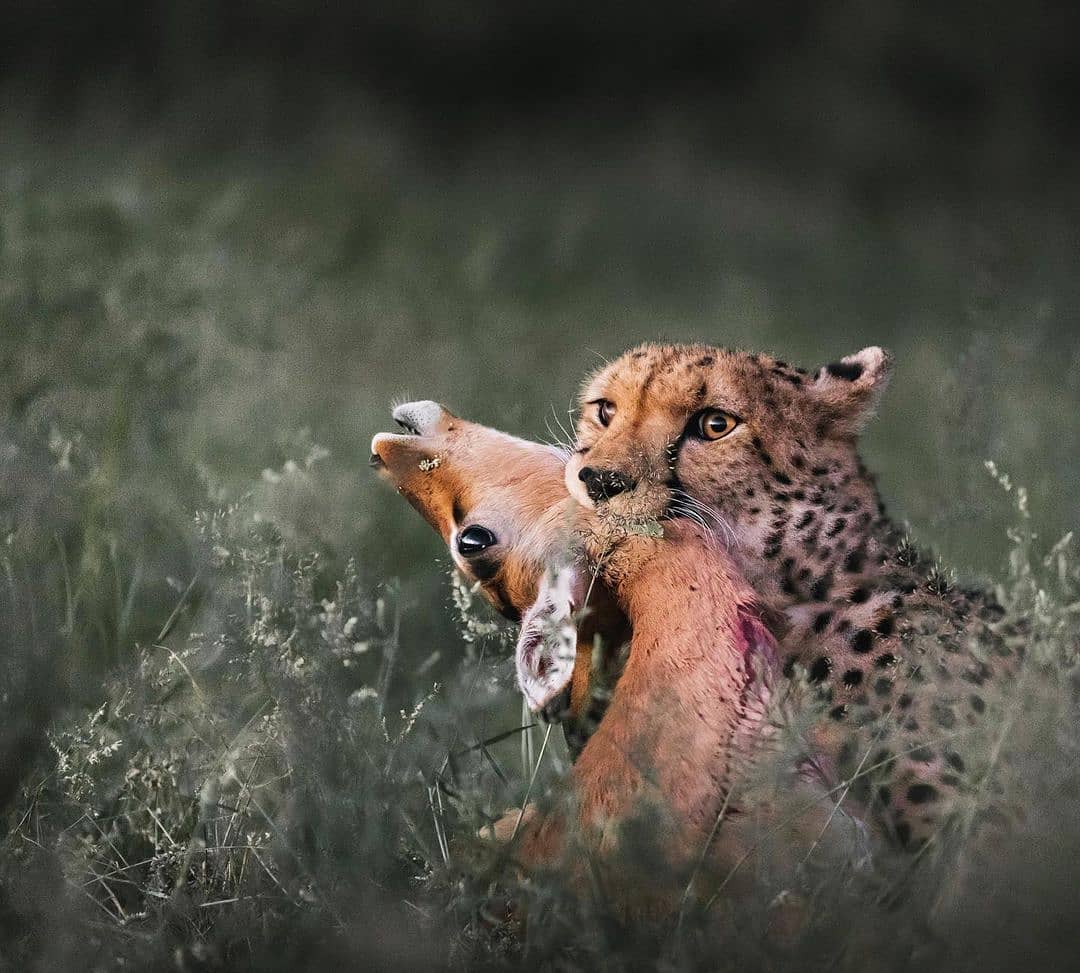
Big cat photography. The Masai Mara and the adjacent Mara Triangle hold the highest density of lions, cheetahs, and leopards of any ecosystem in Africa. The ratio of predators to prey — and the open grassland terrain that gives photographers long sight lines and unobstructed backgrounds — makes the Mara the gold standard for big cat imagery. Three days is enough to photograph all three species in hunting, resting, and interaction contexts with high probability.
The Mara Triangle. The western section of the reserve, managed by the Mara Conservancy, typically has lower vehicle pressure than the main reserve and is where the most intimate predator encounters are achieved. Your guide knows which sectors deliver the finest photographic results for each species.
🍽️ Meals: All full-board · 🏨 Overnight: Ashnil Mara Camp / Sarova Mara Game Camp
Day 14 — Final Dawn Drive and Return to Nairobi
Last golden-hour session before the Wilson Airport flight. The dawn in the Mara on the final morning — knowing this is the last chance — produces a specific quality of attention from photographers that often delivers the trip's finest frame. Internal flight Masai Mara to Wilson Airport Nairobi included. Transfer to Jomo Kenyatta International Airport for international departure.
🍽️ Meals: Breakfast · ✈️ Internal flight: Masai Mara (Keekorok airstrip) to Wilson Airport, Nairobi
📸 The Photography - Technical Briefing for Serious Photographers
Golden Hour Times Per Destination
Golden-hour light — the 30 to 45 minutes after sunrise and before sunset — is the primary reason professional wildlife photographers wake at 04:30 and return to camp long after other vehicles. At the equatorial latitudes of Kenya and Tanzania, the light transition from blue to golden is faster and more dramatic than at higher latitudes. The window is short and it requires being positioned before it starts.
| Destination | Dawn Drive Depart | Golden Hour (Sunrise) | Golden Hour (Sunset) |
|---|---|---|---|
| Tsavo (Kilaguni area) | 05:45 | 06:15 to 07:00 | 17:45 to 18:30 |
| Amboseli | 05:30 | 06:10 to 07:00 | 17:50 to 18:30 |
| Lake Manyara | 06:00 | 06:30 to 07:15 | 18:00 to 18:45 |
| Ngorongoro Crater | 05:30 | 07:00 to 07:45 (post-crater descent) | 17:30 to 18:15 |
| Serengeti | 05:30 | 06:30 to 07:15 | 18:00 to 18:45 |
| Masai Mara | 05:45 | 06:30 to 07:15 | 18:00 to 18:45 |
Vehicle Setup and Photography Equipment
Your vehicle:
🚙 Private 4×4 Toyota Land Cruiser — 2 photographers maximum per vehicle for maximum gear space and shooting angles
🔓 360° roof hatch — standing height for telephoto work without lens obstruction
🫘 Bean bags — provided on all vehicles. Critical for telephoto stabilisation at 400mm to 600mm. Do not rely on your vehicle's windowsill.
🔌 Dual 12V and USB-C charging points — running continuously during game drives. Battery management is genuinely important on a 14-day safari.
📡 Guide-to-guide radio — your guide communicates with other Wild Springs and partner vehicles to share sighting intelligence across the park in real time.
Recommended Lens Focal Lengths per Subject
| Subject | Recommended Focal Length | Setting | Notes |
|---|---|---|---|
| Elephant herds at range | 200 to 400mm | f/5.6 to f/8, ISO 400 to 800 | Bean bag essential at Tsavo morning distances |
| Amboseli Kilimanjaro backdrop | 70 to 200mm | f/8 to f/11, low ISO | Wide enough to include mountain and herd in one frame |
| Big cat close encounter | 300 to 500mm | f/4 to f/5.6 | Shallow depth of field isolates the subject |
| River crossing | 400 to 600mm + wide | Both — switch between them | Telephoto for individual drama, wide for scale |
| Ngorongoro rim landscape | 16 to 35mm | f/11 to f/16 | Include crater wall in foreground |
| Bird in flight | 500 to 600mm | f/6.3, high shutter 1/2000+ | African Fish Eagle and flamingo flocks |
| Underwater hippo (Mzima) | Waterproof housing or polariser | — | Reduce surface reflection |
💰 2026 Pricing — 14-Day Kenya Tanzania Photography Safari
Based on private vehicles, 2 photographers per vehicle, full-board accommodation, all internal flights, and all cross-border logistics. Park fees are in addition to the package price — they are itemised separately below for full transparency.
Package Price Per Person
| 👥 Group Size | 🌐 Non-Residents (USD) | Notes |
|---|---|---|
| 2 Persons | $2,850 pp | 1 private Land Cruiser for 2 — maximum photography space |
| 4 Persons | $1,980 pp | 2 private vehicles — 2 photographers per vehicle |
| 6 Persons | $1,650 pp | 3 private vehicles |
| 8 to 12 Persons | $1,350 pp | 4 to 6 vehicles — best group rate |
Estimated Park Fee Budget — Per Person (Paid Separately at Gates)
This is the most important financial disclosure on this page. Tanzania and Kenya national park fees are substantial and must be budgeted in addition to the package price. These are approximate 2026 rates — confirm at booking as KWS and TANAPA adjust fees annually.
| Park | Country | Fee Type | Approximate Fee Per Person Per Day | Your Days |
|---|---|---|---|---|
| Tsavo East or West | Kenya | Non-resident entry | $70 | 2 days = $140 |
| Amboseli | Kenya | Non-resident entry | $80 | 2 days = $160 |
| Lake Manyara | Tanzania | Non-resident entry | $70 | 1 day = $70 |
| Ngorongoro Crater | Tanzania | Crater service fee | $295 (incl. conservation area) | 2 days = $590 |
| Serengeti | Tanzania | Non-resident entry | $82 | 3 days = $246 |
| Masai Mara | Kenya | Non-resident entry | $200 (peak July–Oct) | 3 days = $600 |
Approximate total park fee budget per person: $1,806 to $1,900 — depending on season and vehicle type.
Total estimated cost per person (package + park fees, 8 to 12 persons): $1,350 + $1,850 = approximately $3,200 per person for the complete 14-day Kenya Tanzania photography safari experience, all-inclusive of flights, accommodation, and parks.
📌 KES pricing available for Kenyan citizens — contact us for full, transparent breakdown.
📌 Deposit: 30% confirms booking · Balance due 60 days before departure on cross-border safaris.
📌 Tanzania visa: $50 single-entry USD at the Namanga border or online at https://eservices.immigration.go.tz · Kenya ETA: $30 online at https://etakenya.go.ke
✅ What Is Included
✔ Private customised 4×4 Toyota Land Cruiser — 2 photographers per vehicle maximum
✔ KPSGA-certified professional safari guide — wildlife behaviour trained for photographer positioning
✔ All accommodation — 13 nights in premium luxury tented camps and lodges
✔ Full-board meals throughout — all breakfasts, lunches, dinners including bush meals
✔ Internal flights — Serengeti to Masai Mara (Keekorok), Masai Mara to Wilson Airport Nairobi
✔ All cross-border logistics — Namanga (Kenya to Tanzania) and Isebania/Migori (Tanzania to Kenya)
✔ Bean bags for telephoto stabilisation — all vehicles
✔ Dual 12V and USB-C charging points running during all game drives
✔ AMREF Flying Doctors emergency air evacuation cover — all 14 days
✔ Emergency first aid kit — mountain-grade carried throughout
✔ 24/7 WhatsApp support during the safari
✔ Pre-safari photographer briefing — vehicle position, golden-hour timing, guide communication protocol
❌ What Is Not Included
✗ Kenya and Tanzania national park and conservation fees — itemised and budgeted above — paid at each park gate. Approximately $1,800 to $1,900 per person total.
✗ Kenya and Tanzania entry visas — Kenya ETA $30 online, Tanzania single-entry $50 at border or online
✗ International flights to Nairobi
✗ Travel insurance — mandatory for a 14-day multi-country safari. Must cover emergency evacuation to $1,000,000.
✗ Hot air balloon — Serengeti or Masai Mara — $500 per person, optional. Book with Wild Springs in advance — balloon flights require 48-hour notice minimum.
✗ Gratuities — KPSGA-certified guides $20 per vehicle per day recommended. Camp staff KES 1,500 per night.
✗ Personal photography equipment
✗ Alcohol above standard camp allowances
🌦️ Best Time for the 14-Day Kenya Tanzania Photography Safari
July to October — Peak Migration and Peak Photography (Most Recommended)
The Masai Mara and Serengeti are both at their most productive during the July to October window. The Great Migration is in or approaching the Mara — with Mara River crossings at their most frequent in August and September. Big cat populations in the Mara reach their annual high as predators concentrate around the wildebeest herds. Ngorongoro and Serengeti remain excellent year-round. Amboseli and Tsavo benefit from post-rain clarity in October.
Book 6 to 12 months in advance for July to August — these are the most competitive months for premium camp availability.
January to March — Calving Season and Second Peak
The Serengeti's southern plains become the calving ground for the wildebeest migration — 8,000 calves per day are born in the concentrated period of late January through February. Predator concentration around the calving herds is extraordinary for cheetah and lion photography. Amboseli is excellent, with clear Kilimanjaro views and elephant herds at the swamps. This is a genuinely excellent alternative to the peak season and is significantly less competitive for bookings.
April to June — Green Season (Variable but Viable)
The long rains bring dramatic skies, lush green landscapes, and significantly lower tourist pressure. The Mara and Serengeti remain operational. For landscape photographers who value dramatic skies and green savanna over migration concentration, this is an underrated window. Camp rates are lower, and vehicles are fewer. The migration is moving north through the Serengeti in May and June.
🔐 Why Book This Photography Safari With Wild Springs Adventures
✔ TRA Licensed Tour Operator — License No. TRA1/47/C01/25895. Regulated by Kenya's Tourism Regulatory Authority.
✔ TripAdvisor Travelers' Choice 2024, 2025 and 2026
✔ KPSGA-Certified Professional Safari Guides — Kenya Professional Safari Guides Association certified. Your guide is trained specifically in wildlife behaviour for photographer positioning — not a driver who has been given a camera briefing.
✔ TOSK Member #0082 — Tour Operators Society of Kenya.
✔ Maximum 4 Photographers Per Vehicle — This is a hard constraint, not a preference. More than 2 photographers per vehicle compromises positioning, gear space, and diverts attention. We do not compromise on this.
✔ Cross-Border Logistics Expertise — Two border crossings, six parks across two countries, internal flights, and 14 days of logistics. Wild Springs has been running multi-country East Africa safaris since 2013. Every logistical contingency has been encountered and resolved.
✔ Operating Since 2013 — Over 11 years of Kenya and Tanzania multi-country safari operations.
⭐ What Our Photography Safari Guests Say
⭐⭐⭐⭐⭐ "The Most Productive Two Weeks of Photography in My Life."
I have shot on four continents and done three previous Africa safaris. This 14-day Wild Springs photography circuit is the most well-structured wildlife photography itinerary I have experienced anywhere. The guide positioned us at the Mara River crossing with 90 minutes of patience before the wildebeest committed — and when they did, we were in the perfect spot. The Tsavo red elephant dawn session on Day 1 set the standard for the whole trip. Every logistical detail was handled perfectly.- Verified Wildlife Photographer, USA · TripAdvisor ✅
⭐⭐⭐⭐⭐ "Ngorongoro Crater at Dawn Was Worth the Entire Journey."
Standing on the crater rim at first light — watching the mist clear below to reveal 25,000 animals in a self-contained world — is one of the finest visual experiences I have ever had, before I even raised a camera. The Wild Springs guide then found us the black rhino by 09:30. The Big Five before lunch in a single caldera. Extraordinary. Flawless organisation.= Verified International Photographer, Germany · TripAdvisor ✅
❓ Frequently Asked Questions — 14-Day Kenya Tanzania Photography Safari
Is this safari suitable for amateur photographers or only professionals?
This itinerary is designed for any photographer who is serious about getting great wildlife images — from enthusiasts with a telephoto kit lens to professional photographers with 600mm prime lenses. The vehicle positioning, guide expertise, and golden-hour timing benefit every level of photographer equally. What differs is the equipment that takes advantage of the positioning — but the positioning is available to everyone regardless of camera system.
What camera equipment should I bring?
-
The core recommendation is a telephoto lens of at least 300mm, preferably 400 to 600mm, for wildlife at range. A second body with a wide-angle (16 to 35mm) or standard zoom (24 to 105mm) handles landscape, habitat, and environmental portraits. Bean bags are provided — do not waste bag space bringing your own. Bring at least 3 batteries per body and enough memory cards for 3,000 images per day at peak moments (river crossings). A polarising filter is essential for Mzima Springs and the Ngorongoro crater rim.
Are park fees really excluded, and how much should I budget?
Yes — Kenya and Tanzania national park fees are substantial and are excluded from the package price to maintain pricing transparency. The full park fee budget is itemised in the pricing section above. Budget approximately $1,800 to $1,900 per person in park fees for the full 14-day circuit. Masai Mara fees at $200 per person per day during peak season are the single largest line item.
What is the maximum number of photographers per vehicle?
Two. This is a hard limit on all Wild Springs photography safari vehicles. More than two photographers per vehicle compromises gear space, shooting angles, guide attention, and positioning decisions. If your group is larger than 2, additional private vehicles are provided. This constraint is why the group rate for 4 persons uses two vehicles — not four photographers in one vehicle.
When is the best time to see Mara River crossings?
The Mara River crossings occur between approximately late July and early October, with the peak frequency in August and September. Individual crossings are not predictable on specific days — the wildebeest build in numbers on the Tanzanian bank, test the water, retreat, and then commit unpredictably. Your guide positions at the crossing points most likely to produce action and waits. The wait is part of the experience — and the moment of commitment is worth every minute.
Are Tanzania and Kenya visas included?
No. Kenya ETA (Electronic Travel Authorisation) costs $30 and is applied for online at https://etakenya.go.ke. Tanzania single-entry visa costs $50 and can be obtained at the Namanga border crossing or applied for online at https://eservices.immigration.go.tz. Wild Springs provides full visa guidance at booking.
Can I combine this photography safari with a Mount Kenya trek?
Yes — Wild Springs operates the full Mount Kenya trekking portfolio, including the 5-day Chogoria Route Trek and the 8-day Nelion and Batian Technical Climb. A Mount Kenya summit attempt before or after the photography safari is an extraordinary extension — contact us to design the combined itinerary.
How do I book the 14-day photography safari?
WhatsApp us at +254 729 257 317 or email [email protected] with your preferred travel dates, group size, accommodation preference (lodge vs tented camp), and any specific photographic subjects you want to prioritise. We confirm availability across all 6 parks and send a full personalised itinerary and pricing within 24 hours. A 30% deposit confirms your booking. Balance due 60 days before departure.
🔗 Related Kenya and Tanzania Safari Experiences
🦁 3-Day Budget Masai Mara Safari from Nairobi — The most affordable Masai Mara safari — ideal for photographers who want to test the Mara before committing to the full 14-day circuit
🐘 2-Day Amboseli Safari from Nairobi — The Kilimanjaro elephant photography experience as a standalone 2-day itinerary
🦓🌌 Samburu National Reserve Luxury Safari — Northern Kenya's Samburu Special Five — the rare species photography that the Mara cannot deliver
🏔️ 5-Day Mount Kenya Chogoria Route Trek — Combine the photography safari with a Mount Kenya summit
🦩 Aberdare and Lake Nakuru Safari Combo — Flamingo photography at Lake Nakuru and waterfalls in the Aberdares — the perfect Nairobi day or overnight extension
Book Your 14-Day Kenya Tanzania Photography Safari
📱 WhatsApp / Call: +254 729 257 317 · +254 734 417 496 · +254 721 957 652
📧 [email protected] · [email protected]
We respond within 2 hours on WhatsApp for standard enquiries and within 24 hours for full customised photography safari quotes. Tell us your dates, group size, and what you most want to photograph. We build the itinerary around your photographic priorities. 📸🦁🏔️
🏆 TripAdvisor Travelers' Choice 2024, 2025 and 2026 ·
✅ TRA Licensed No. TRA1/47/C01/25895 ·
🏛️ TOSK Member #0082 ·
🌍 Wikidata Verified Entity Q138856997
We never request payment through social media, personal phone numbers, or any account or link not confirmed in writing by our office. If in doubt, call us before paying anyone.
Where You Will Visit
This safari explores the following regions in Kenya, Tanzania
- Masai Mara
- Nakuru
- Ngoro Ngoro
- Serengeti