🏔️Kamweti Route Mount Kenya Climb 2026 - 4-Day Off-Trail Wilderness Trek To Point Lenana 4,985M
Safari at a Glance
Wild Springs Adventures · Nairobi-Based Mount Kenya Specialists Since 2013
The Mount Kenya Route That 95% of Climbers Never Take
Ninety percent of Mount Kenya climbers use three routes. Naro Moru. Sirimon. Chogoria. They are well-marked, well-staffed, and well-worn. They are excellent routes.
The Kamweti Route is something else entirely.
Approaching from Mount Kenya's southern slopes, the Kamweti trail starts 137km from Nairobi. It begins at Castle Forest Lodge near Kutus in Kirinyaga County. It climbs through dense montane forest, past the thundering Kamweti Falls, deep into Kenya's most spectacular bamboo zone, across the longest moorland traverse on the mountain, through the alien giant lobelia landscape of Taleki Valley at 3,755m, and to Point Lenana at 4,985m — Africa's second-highest summit by prominent peak.
There are no mountain huts on the Kamweti Route. There are no crowds. There are no cafes at the gate or well-worn boardwalks through the moorland. There is only the mountain, the bamboo, the cold stars above your tent, and the summit you earned.
The Mountain Club of Kenya describes the Kamweti Route as requiring "considerable navigation skill, physical strength, and stamina." This is not a warning. It is an invitation.
Wild Springs Adventures holds the KWS special permit required to operate the Kamweti Route. We supply KWS-certified guides with active Kamweti route expertise. We handle every logistics detail — permit, ranger coordination, porters, full camping — so you focus entirely on the climb.
Mount Kenya Kamweti Route At a Glance
| Feature | Details |
|---|---|
| 🏁 Start Point | Castle Forest Lodge / Kamweti Forest Station (2,400 to 2,600m) |
| 🎯 Summit | Point Lenana (4,985m) — Africa's second-highest trekking peak |
| ⛺ High Camp | Mackinder's Camp (4,300m) |
| 📏 Total Distance | Approximately 45km (full route) |
| 🗺️ Region | Kirinyaga County, southern slopes of Mount Kenya |
| 📍 Distance from Nairobi | 137km — approximately 3 to 3.5 hours |
| 🧗 Route Type | Full camping — no mountain huts anywhere |
| ⭐ Difficulty | Challenging — 4 out of 5 |
| ❄️ Min Temperature | -10°C at summit night |
| 📅 Best Seasons | January to March · July to October |
| ⏱️ Duration | 4 Days / 3 Nights |
| 🪖 Special Permit | KWS special permission required — included in package |
| 🪖 KWS Ranger | Required by park — fully arranged and included |
| 💰 Price From | KES 52,999 per person |
Why the Kamweti Route Is in a Category of Its Own
The Rarest Route on Africa's Second-Highest Mountain
Only 5% of Mount Kenya climbers ever set foot on the Kamweti trail. The remaining 95% choose the three main routes. This means genuine solitude.
You will not pass other teams on the Kamweti. You will not hear another camp. You will hear the bamboo, the river, and the wind.
The Most Spectacular Bamboo Forest on Mount Kenya
Every Mount Kenya route passes through some bamboo. The Kamweti Route passes through the most extensive and most dramatic bamboo zone on the entire mountain. Day 2 spends hours inside this world. It is unlike anything else on the climb.
The Sagana River Headwaters
The route passes along the upper reaches of the Sagana River. This is Kenya's longest river. It flows from these slopes all the way to the Indian Ocean. Seeing its birth as a mountain stream — weeks before it becomes a lowland river — is a remarkable geography lesson.
Kamweti Falls - A Secret Waterfall
On Day 1, the trail passes the Kamweti Falls. Two cascading falls set inside dense, isolated rainforest. Almost no Mount Kenya visitors ever see them. They are only accessible from this route.
Taleki Valley - The Lobelia Zone
At 3,755m, the trail enters Taleki Valley. Giant lobelias and senecios — the alien-looking high-altitude flora unique to East African mountains — fill the valley floor. This transition into the lobelia zone is one of the Kamweti Route's most photographically extraordinary sections.
Lake Howell - The High-Altitude Lake
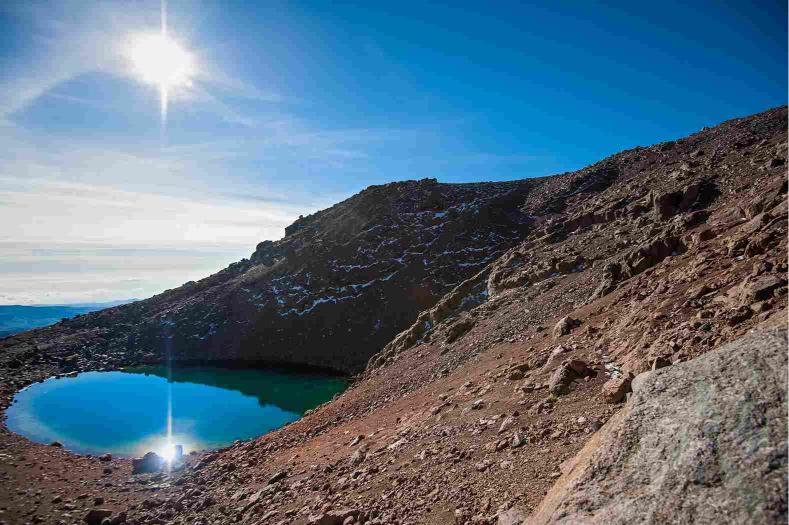
Near Mackinder's Camp, the trail skirts Lake Howell (also known as Lake Höhnel). Few trekkers reach this lake. The Kamweti approach gives a perspective on it that the main routes cannot provide.
Full 4-Day Kamweti Route climb Itinerary
Day 1 - Nairobi to Castle Forest Lodge to Forest Camp
Altitude: 2,400m to 2,800m · Hiking: 5km · Drive: 137km from Nairobi
Your Kamweti Route climb begins before dawn. Your Wild Springs KWS-certified guide and driver collect you from Nairobi. The drive heads north through the Central Highlands. You arrive at Castle Forest Lodge - the southern gateway to the Kamweti Route.
Alternatively, drive 6km further to Kamweti Forest Station at 2,600m. This shortens Day 1 and adds elevation from the start. Your guide advises based on your group's fitness and schedule.
At the gate, KWS park registration and the KWS Ranger join the group. KWS Rangers accompany all Kamweti Route expeditions. This is a park requirement on wild-animal routes without official gates. Your ranger is part of the team for the full climb.
05:30 — Depart Nairobi
08:30 — Arrive Castle Forest Lodge (2,400m)
09:00 — Briefing, gear check, KWS registration
09:30 — Begin ascent through dense montane forest
10:30 — Kamweti Falls viewpoint — two cascading falls in isolated rainforest
12:30 — Lunch in the forest at approximately 2,700m
14:00 — Enter lower bamboo zone — elephant tracks are common here
16:30 — Reach Forest Camp (2,800m)
19:00 — Dinner, star-gazing, altitude briefing
🍽️ Meals: Dinner · 🏕️ Camp: Forest Camp (2,800m)
Day 2 - Forest Camp Through the Bamboo Zone to High Moorland Camp
Altitude: 2,800m to 3,500m · Hiking: 10km · Time on trail: 8 hours
Day 2 is the Kamweti Route's signature experience. Today, you enter the bamboo zone.
Towering green columns close around you. The forest floor softens. Light filters through in shafts. Sound changes character completely inside the bamboo. This section continues for hours. No other Mount Kenya route gives you this.
Emerging from the bamboo, the landscape opens. The heather moorland appears suddenly. The peaks of Mount Kenya fill the horizon for the first time. The Sagana River headwaters trace their path below you.
07:00 — Breakfast, break camp
08:00 — Enter bamboo forest zone — the route's most iconic section
10:00 — Deep bamboo — navigation requires focus
11:00 — Emerge from bamboo into heather moorland (3,200m)
11:30 — First unobstructed views of Mount Kenya's peaks
13:00 — Lunch on the moorland
15:00 — Continue through open moorland and giant heather zones
17:00 — Reach High Moorland Camp (3,500m)
19:00 — Dinner, acclimatisation exercises, summit briefing
🍽️ Meals: Breakfast, lunch, dinner · 🏕️ Camp: High Moorland Camp (3,500m)
Day 3 - High Moorland to Taleki Valley to Mackinder's Camp
Altitude: 3,500m to 4,300m · Hiking: 8km · Altitude begins here
Day 3 enters otherworldly territory. The giant lobelia and senecio plants of Taleki Valley at 3,755m line the route. These plants grow nowhere else on Earth except East Africa's high mountains.
The landscape becomes starkly beautiful. Each step gains altitude. The air thins noticeably. Mackinder's Camp at 4,300m sits beneath the glaciated peaks. Arriving here feels like arriving somewhere genuinely significant.
Rest is the primary activity at Mackinder's Camp. Your guide will insist on it. Sleep is your most important summit preparation tool.
07:00 — Breakfast, break camp. Layers on.
08:30 — Ascent through giant lobelia and senecio zones
10:00 — Enter Taleki Valley (3,755m) — lobelia zone photography
11:00 — Lake Howell (Lake Höhnel) approach — spectacular high-altitude lake
13:00 — Arrive Mackinder's Camp (4,300m)
14:00 — Rest, hydrate, acclimatise. No exertion.
16:00 — Optional short acclimatisation hike to 4,400m and back
18:00 — Early dinner. 03:00 wake-up tomorrow.
🍽️ Meals: Breakfast, lunch, dinner · 🏕️ Camp: Mackinder's Camp (4,300m)
Day 4 - Summit Push to Point Lenana (4,985m) and Descent
Altitude: 4,300m to 4,985m to 3,050m · Summit day · Pre-dawn start essential
The summit push begins in complete darkness. Headlamps on. Every step is deliberate. The final 685 vertical metres to Point Lenana at 4,985m take approximately 3.5 hours in summit conditions.
At the top: Africa's second-highest mountain beneath your boots. The sunrise from Point Lenana on a clear morning is one of the finest natural sights on the continent. Glaciers on Batian and Nelion above. The Central Highlands spreads to the south. The Aberdares are visible on the western horizon.
Then the descent via Naro Moru is faster, well-defined, bringing you to a lower altitude quickly.
02:30 — Wake up, hot drinks, final gear check
03:00 — Summit push begins
06:30 — Sunrise at Point Lenana (4,985m)
07:30 — Begin descent via Naro Moru route
13:00 — Reach Met Station (3,050m)
16:00 — Arrive Naro Moru Gate — vehicle waiting
19:00 — Return to Nairobi
🍽️ Meals: Breakfast, packed lunch · 🚐 Transport: Naro Moru Gate to Nairobi
2026 Pricing - Kamweti Route Mount Kenya Climb
All prices are per person. They include KWS permits, special Kamweti route permission, KWS Ranger, KWS-certified guide, full camping equipment, all meals from Day 1 dinner through Day 4 lunch, porters, park fees, and AMREF cover.
| 👥 Group Size | 🇰🇪 Citizens (KES) | 🌍 East African Residents (KES) | 🌐 Non-Residents (USD) |
|---|---|---|---|
| 1 Person | 72,000 | 75,000 | $680 |
| 2 Persons | 62,000 pp | 65,000 pp | $580 pp |
| 3 Persons | 57,000 pp | 60,000 pp | $540 pp |
| 4 Persons | 52,999 pp | 56,000 pp | $500 pp |
| 5 to 7 Persons | 50,000 pp | 53,000 pp | $475 pp |
📌 Private departures throughout the year — no fixed schedule
📌 KWS park fees for non-East-African residents are higher and factored into the quote
📌 Deposit: 30% confirms booking · Balance due 14 days before departure
📌 Sleeping bag rated -15°C or colder is mandatory. Rental available from Wild Springs — ask at booking.
What Is Included
✔ KWS-certified professional mountain guide with active Kamweti route expertise
✔ KWS special route permission — Kamweti requires this, and we handle it entirely
✔ KWS Ranger accompaniment — mandatory on this route, fully coordinated and included
✔ All camping equipment — tents, sleeping mats, cooking gear, fuel
✔ All meals: Day 1 dinner through Day 4 packed lunch
✔ Mount Kenya National Park entry fees for all days
✔ Porters — 1 porter per 2 guests for group camping equipment
✔ Emergency first aid kit and supplemental oxygen
✔ Transport: Nairobi to Castle Forest Lodge and return from Naro Moru Gate
✔ Pre-climb briefing and Kamweti route orientation
✔ AMREF Flying Doctors emergency air evacuation cover
What Is Not Included
✗ Personal travel and medical insurance — mandatory, required before booking
✗ Personal trekking gear — boots, trekking poles, personal layers, sleeping bag (-15°C rated)
✗ Sleeping bag rental — available from Wild Springs, ask at booking
✗ Tips and gratuities for guides and porters — strongly encouraged
✗ Alcoholic beverages
✗ Personal snacks and energy supplements
✗ Helicopter rescue in case of evacuation requiring air transport
✗ Accommodation outside the itinerary if the journey is extended
Fitness and Difficulty Rating
The Kamweti Route is rated Challenging — 4 out of 5. No technical climbing is required. But physical fitness is non-negotiable.
This is a serious multi-day mountain expedition. The Mountain Club of Kenya formally classifies Kamweti as requiring "considerable navigation skill, physical strength, and stamina." Be honest with yourself about your preparation before booking.
You must be comfortable with:
Carrying a 10 to 14kg daypack for 6 to 10 hours daily. High-altitude camping at temperatures down to -10°C. Off-trail sections requiring navigation and focus. Altitude acclimatisation above 3,000m for multiple consecutive days.
Recommended preparation: At least 6 months of regular hiking and cardio training before the climb. Prior high-altitude experience is beneficial but not required. Discuss your fitness history with us before booking, and we will give you an honest assessment.
Altitude Safety - What You Need to Know
Altitude sickness (AMS — Acute Mountain Sickness) is a real risk above 3,000m. The Kamweti Route's gradual ascent provides a natural acclimatisation advantage over faster routes.
All Wild Springs KWS-certified guides are trained in AMS recognition and high-altitude emergency response. We carry supplemental oxygen and enforce a strict "climb high, sleep low" protocol throughout the expedition.
Any climber showing serious AMS symptoms will descend immediately. No summit justifies your health. Your guide has the authority and the instruction to make this call.
What to Pack for the Kamweti Route
Wild Springs provides all group camping equipment and meals. You are responsible for your personal gear.
| Item | Notes |
|---|---|
| 👟 Waterproof Hiking Boots | Ankle support essential. Break in before the climb. |
| 🎿 Trekking Poles | Non-negotiable on off-trail terrain |
| 🛏️ Sleeping Bag (-15°C rated) | Mackinder's Camp nights are brutal — do not underestimate |
| 🧥 Thermal Base Layers | Top and bottom. Merino or synthetic — never cotton |
| 🌧️ Waterproof Jacket and Trousers | Mount Kenya weather changes fast at all altitudes |
| 🧢 Sun Hat and Warm Beanie | Daytime sun is intense. Summit nights are freezing. |
| 🕶️ Sunglasses (UV400 rated) | High-altitude UV is severe |
| 💡 Headlamp and Spare Batteries | Mandatory for the 03:00 summit push |
| 💧 Hydration Pack (3L minimum) | Hydration is your primary defence against AMS |
| 🩹 Personal First Aid Kit | Blister pads, paracetamol, Diamox (on prescription) |
| ☀️ High-SPF Sunscreen and Lip Balm | Reapply every 2 hours above 3,000m |
| 🎒 Daypack (25 to 35L) | Porters carry camp equipment — you carry your essentials |
Related Mount Kenya and Adventure Tours
🏔️ Mount Kenya Group Joining Climbs - Join a small group, share costs, meet new persons nd have fun.
🏔️ 5-Day Mount Kenya Chogoria Route Trek - Mount Kenya's most scenic route. Lake Michaelson, the Gorges Valley, and Harris Tarn. Point Lenana via the finest approach on the mountain.
🏔️ Burguret Chogoria Traverse - Another rare western-approach route. Bongo habitat. Mountain Castle Camp at 3,700m. A similarly exclusive wilderness experience.
🏔️ Mount Kenya Day Hike - Sirimon Route — For those who want to experience Mount Kenya in a single day before committing to the Kamweti multi-day expedition.
🎣 Lake Michaelson Fly Fishing Mountain Safari — The Gorges Valley's extraordinary high-altitude lake. Fly fishing at 3,950m. A completely different face of Mount Kenya.
🏔️ 8-Day Nelion and Batian Technical Climb — The full technical ascent of Mount Kenya's two highest peaks for roped climbers. The ultimate Mount Kenya commitment.
Book Your Kamweti Route Climb
📱 WhatsApp / Call: +254 729 257 317 · +254 734 417 496
📧 [email protected] · [email protected]
We respond within 24 hours to mountain expedition enquiries. Tell us your preferred dates, group size, and fitness background. We give you an honest assessment and a full personalised quote. 🏔️
This is the Reason Wild Springs Adventures
✔ TRA Licensed Tour Operator — License No. TRA1/47/C01/25895
✔ TripAdvisor Travelers' Choice 2024 and 2025 — Top 10% globally
✔ KWS-Certified Professional Mountain Guides — Kenya Wildlife Service certified. Active Kamweti route expertise.
✔ TOSK Member #0082 — Tour Operators Society of Kenya
✔ AMREF Flying Doctors Cover Included — Emergency air evacuation for all 4 days
✔ KWS Special Permit Holders — Kamweti requires special KWS permission. We hold it. We handle it.
✔ Operating Since 2013 — Over 11 years of Mount Kenya expeditions
What Our Guests Say
⭐⭐⭐⭐⭐ "The Most Rewarding Mountain Experience of My Life."
I have climbed Kilimanjaro. I have done the Inca Trail. The Kamweti Route on Mount Kenya was harder, more beautiful, and more emotionally satisfying than either. The bamboo zone on Day 2 is unlike anything I have seen on any mountain anywhere in the world. The Wild Springs guide knew every section of this route personally. Not from a guidebook. From having walked it repeatedly. That is the difference. Book this climb.- Verified International Mountaineer, United Kingdom · TripAdvisor ✅
⭐⭐⭐⭐⭐ "I Chose Kamweti Because I Wanted the Real Mountain. I Got It."
The summit was the goal. But the bamboo forest on Day 2 was the experience. Standing in a 10-metre-high bamboo with no trail visible and trusting the guide was one of the most alive moments of my life. The Kamweti Falls on Day 1 are completely unknown. Two enormous waterfalls in an isolated forest that 95% of Mount Kenya climbers never see. Extraordinary throughout.
— Verified Repeat Client, South Africa · TripAdvisor ✅
Frequently Asked Questions about the Kamweti Route Mount Kenya Climb
What is the Kamweti Route, and where does it start?
The Kamweti Route is one of Mount Kenya's least-used and most adventurous trails. It approaches from the mountain's southern slopes in Kirinyaga County, 137km from Nairobi. You start at Castle Forest Lodge or drive 6km further to Kamweti Forest Station at 2,600m. The route passes through dense montane forest, Kamweti Falls, the mountain's most spectacular bamboo zone, Taleki Valley, Lake Howell, and Mackinder's Camp at 4,300m — before the summit push to Point Lenana at 4,985m.
Does the Kamweti Route require a special KWS permit?
Yes. The Kamweti Route does not have an official KWS park gate. KWS special permission is required to operate this route legally. Wild Springs Adventures holds the required KWS permits and handles all registration and administration. You do not need to arrange anything — it is included in the package.
Are KWS Rangers required on the Kamweti Route?
Yes. Kenya Wildlife Service requires rangers to accompany groups on routes like Kamweti because the trail passes through active wildlife country without official park gate infrastructure. Your KWS Ranger joins the group at the start and accompanies the full expedition. The ranger fee is included in the Wild Springs package price.
How does Kamweti compare to Sirimon or Naro Moru?
Sirimon and Naro Moru are well-marked, staffed, and used by the majority of Mount Kenya climbers. They have mountain huts, defined tracks, and significant traffic. Kamweti has none of these. No mountain huts. Less defined trail. Off-trail navigation sections. The most extensive bamboo forest on the mountain. Far fewer trekkers. The Mountain Club of Kenya describes Kamweti as requiring "considerable navigation skill, physical strength, and stamina." It demands more and rewards more.
What altitude does the Kamweti Route reach?
The Kamweti Route reaches Point Lenana at 4,985m. It starts at 2,400m at Castle Forest Lodge, or 2,600m at Kamweti Forest Station. It passes through High Moorland Camp at 3,500m, Taleki Valley at 3,755m, and Mackinder's Camp at 4,300m before the summit push.
What is the risk of altitude sickness on the Kamweti Route?
AMS is a real risk above 3,000m on any Mount Kenya route. The Kamweti Route's gradual ascent profile provides a natural acclimatisation advantage. All Wild Springs KWS-certified guides are trained in AMS recognition and emergency response. We carry supplemental oxygen and enforce a strict "climb high, sleep low" protocol. Any climber showing serious AMS symptoms will descend immediately — guide authority overrides summit goals.
What are the best seasons for the Kamweti Route?
January to March and July to October — Kenya's drier periods. The long rains (April to May) and short rains (November) make the off-trail bamboo sections extremely muddy and the moorland route very difficult. Wild Springs operates climbs year-round but provides an honest seasonal assessment at booking.
Can I depart from somewhere other than Nairobi?
Yes. You can arrange pickup from Meru, Nanyuki, Embu, or Kerugoya. You can also meet the group directly at Castle Forest Lodge if you are travelling independently. Contact us to build the logistics around your travel arrangements.
How do I book the Kamweti Route Mount Kenya climb?
WhatsApp us at +254 729 257 317 or email [email protected] with your preferred dates, group size, and fitness background. We confirm availability, assess your preparation, and send a full personalised quote within 24 hours. A 30% deposit confirms your booking.
🏆 TripAdvisor Travelers' Choice 2024 & 2025 · ✅ TRA Licensed No. TRA1/47/C01/25895 · 🏛️ TOSK Member #0082 · 🌍 Wikidata Q138856997
We never request payment through social media, personal phone numbers, or any account or link not confirmed in writing by our office. If in doubt, call us before paying anyone.
Where You Will Visit
This safari explores the following regions in Kenya
- Timau, Meru County
- Chogoria, Tharaka-Nithi County
- Kirinyaga County